A Structural Equation Model of Family-of-Origin Experiences, Relationship Beliefs, Communication Patterns, and Couple Satisfaction
Keywords:
family-of-origin experiences, relationship beliefs, communication patterns, couple satisfactionAbstract
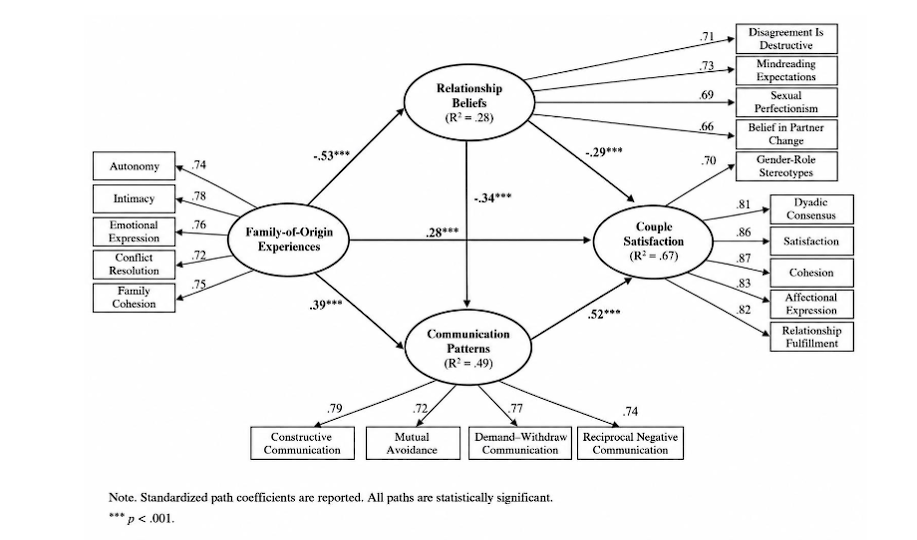
The present study aimed to examine a structural equation model investigating the direct and indirect relationships among family-of-origin experiences, relationship beliefs, communication patterns, and couple satisfaction among adults in the United States. This cross-sectional correlational study was conducted among 618 adults (309 couples) residing in the United States who were involved in committed romantic relationships. Participants were recruited through community organizations, counseling centers, social media platforms, and online survey panels. Data were collected using the Family-of-Origin Scale (FOS), Relationship Belief Inventory (RBI), Communication Patterns Questionnaire–Short Form (CPQ-SF), and Couple Satisfaction Index (CSI-32). Descriptive statistics, Pearson correlation analyses, confirmatory factor analysis, and structural equation modeling were performed using SPSS 29 and AMOS 29. Model fit was evaluated using χ²/df, CFI, TLI, GFI, AGFI, RMSEA, and SRMR indices. Bootstrapping with 5,000 resamples was employed to assess indirect effects and mediation pathways. Correlation analyses revealed significant associations among all study variables. Family-of-origin experiences were negatively associated with dysfunctional relationship beliefs and positively associated with communication patterns and couple satisfaction (p < .001). The measurement model demonstrated satisfactory psychometric properties, with all factor loadings, composite reliability coefficients, and average variance extracted values exceeding recommended thresholds. The structural model exhibited excellent fit to the data (χ²/df = 2.31, CFI = .962, TLI = .956, GFI = .932, AGFI = .914, RMSEA = .046, SRMR = .041). Family-of-origin experiences significantly predicted relationship beliefs (β = -.53, p < .001), communication patterns (β = .39, p < .001), and couple satisfaction (β = .28, p < .001). Relationship beliefs significantly predicted communication patterns (β = -.34, p < .001) and couple satisfaction (β = -.29, p < .001). Communication patterns emerged as the strongest direct predictor of couple satisfaction (β = .52, p < .001). Significant indirect effects confirmed that relationship beliefs and communication patterns partially mediated the relationship between family-of-origin experiences and couple satisfaction. The model explained 28% of the variance in relationship beliefs, 49% of the variance in communication patterns, and 67% of the variance in couple satisfaction. The findings support a developmental-relational model in which family-of-origin experiences influence adult couple satisfaction both directly and indirectly through relationship beliefs and communication patterns. Communication patterns emerged as the most influential determinant of couple satisfaction, highlighting their central role in relationship functioning. The results suggest that interventions targeting maladaptive relationship beliefs and communication processes may help mitigate the negative effects of adverse family experiences and enhance relationship quality among couples.
Downloads
References
Adler‐Baeder, F., Gregson, K. D., Jones, C. W., Papernow, P. L., Browning, S., Kenney, K. R., & Kenney, M. E. (2022). Couple Instability: A Focus on Fragile Families, Stepfamilies, Families With a Child on the Autism Spectrum, and Multiracial Families. 61-92. https://doi.org/10.1037/0000280-004
Aragoni, H. K., Stanley, S. M., Smith-Acuña, S., & Rhoades, G. K. (2023). Religiosity and Relationship Quality in Dating Relationships. Couple and Family Psychology Research and Practice, 12(2), 103-117. https://doi.org/10.1037/cfp0000177
Ashraf, R., Syed, U. E., Khan, A., & Bibi, N. (2024). The Moderating Role of Marital Adjustment in Relationship Between Perceived Maternal Parenting Styles and Family Functioning Among Fathers. Canadian Journal of Family and Youth / Le Journal Canadien De Famille Et De La Jeunesse, 16(2), 91-111. https://doi.org/10.29173/cjfy30003
Brik, A. B., & Wang, Y. (2024). Family Resources, Resilience Beliefs, and Parental Adaptation: A Moderated Mediation Analysis. Family Process, 64(1). https://doi.org/10.1111/famp.13067
Brik, A. B., & Wang, Y. (2025). Factors Influencing Parental Adaptation: A Double ABC‐X Model Approach. Family Relations. https://doi.org/10.1111/fare.70038
Brik, A. B., Williams, N. A., & Ladd, S. B. (2023). Stressor Pileup, Family and Couple Relational Well‐being, and Parent Stress During the COVID‐19 Pandemic. Family Relations, 73(1), 95-115. https://doi.org/10.1111/fare.12982
Carrese‐Chacra, E., Hollett, K. B., Erdem, G., Miller, S., & Gouin, J. P. (2023). Longitudinal Effects of Pandemic Stressors and Dyadic Coping on Relationship Satisfaction During the COVID‐19 Pandemic. Family Relations, 72(3), 645-664. https://doi.org/10.1111/fare.12885
Chen, S., Murphy, D., & Joseph, S. (2023). Dispositional Authenticity, Facilitativeness, Femininity Ideology, and Dyadic Relationship Functioning in Opposite‐gender Couples: Actor‐partner Interdependence Analysis. Asian Journal of Social Psychology, 27(1), 101-126. https://doi.org/10.1111/ajsp.12584
Chen, W. W., Zhang, L. R., & Wu, C. W. (2024). Filial Piety Belief Profiles Among Chinese Couples: Associations With Relationship Satisfaction and Insecure Attachment. Asian Journal of Social Psychology, 27(4), 939-954. https://doi.org/10.1111/ajsp.12649
Fiorenza, E., Gazzillo, F., Mannocchi, C., Santodoro, M., Filippo, C. D., & Crisafulli, V. (2024). Chronic Couple Conflictuality According to Control-Mastery Theory. Journal of Psychotherapy Integration, 34(4), 434-449. https://doi.org/10.1037/int0000352
Fitriani, R., & Arifah, P. (2022). Working Women’s Marital Adjusment in Terms of Communication Skills. Dimedcom, 1(2), 98-107. https://doi.org/10.35760/dimedcom.2022.v1i2.7151
Harel, T., & Koslowsky, M. (2022). Relationship Expectations, Behavior Interactions and Commitment: A Dyadic Study Among Dual-Earner Couples. Psychological Reports, 126(6), 2834-2855. https://doi.org/10.1177/00332941221092659
Kaur, M., & Singh, M. (2025). Money in Couples: A Systematic Literature Review on Intrahousehold Financial Management. International Journal of Consumer Studies, 49(4). https://doi.org/10.1111/ijcs.70100
Kornaszewska-Polak, M. (2021). The Crisis of Dialogue and Relationship in Marriage in the Perspective of the Attachment Theory. Kwartalnik Naukowy Fides et Ratio, 46(2), 205-221. https://doi.org/10.34766/fetr.v46i2.839
Lağap, A. C., & Güngör, D. (2025). Looking for Stability in Chaos: A Scoping Review of Relational Turbulence Theory From a Dyadic Perspective. Journal of Family Theory & Review. https://doi.org/10.1111/jftr.70033
McPherson, C., & Devereaux, A. (2023). A Dyadic Examination of Patients' and Caregivers' Attachment Orientations and Mutually Supportive Care in Cancer Caregiving. Psycho-Oncology, 33(1). https://doi.org/10.1002/pon.6256
Miscioscia, M., Carli, P. D., Sacchi, C., Tasker, F., & Simonelli, A. (2021). Attachment Matching and Coparental Interactions in Same-Sex and Different-Sex Couples Planning Parenthood. 153-179. https://doi.org/10.1007/978-3-030-51988-9_8
Neu, C., & Bradford, A. B. (2025). Autism in Romantic Relationships: A Content Analysis of Challenges and Strengths (2013–2024). Journal of Family Theory & Review, 17(3), 600-635. https://doi.org/10.1111/jftr.70001
Ogolsky, B. G., & Stafford, L. (2022). A Systematic Review of Relationship Maintenance: Reflecting Back and Looking to the Future. Personal Relationships, 30(1), 19-43. https://doi.org/10.1111/pere.12429
Parsons, A., Scott, S. B., Knopp, K., Nguyen, P., Markman, H. J., & Stanley, S. M. (2021). We Are Not All the Same: The Importance of Perceived Difference in Racial Ideology and Afrocentricity for African American Relationships. Family Process, 60(4), 1249-1263. https://doi.org/10.1111/famp.12723
Pentel, K. Z., & Baucom, D. H. (2022). A Clinical Framework for Sexual Minority Couple Therapy. Couple and Family Psychology Research and Practice, 11(2), 177-191. https://doi.org/10.1037/cfp0000187
River, L. M., Treter, M. O., Rhoades, G. K., & Narayan, A. J. (2021). Parent–Child Relationship Quality in the Family of Origin and Later Romantic Relationship Functioning: A Systematic Review. Family Process, 61(1), 259-277. https://doi.org/10.1111/famp.12650
Su, T. (2023). Challenges and Stressors in Intimate Intercultural Relationships: A Systematic Research Synthesis. Personal Relationships, 30(2), 379-398. https://doi.org/10.1111/pere.12489
Uluyol, F. M., & Özen‐Çıplak, A. (2024). Dyadic Relationship of Adult Attachment Patterns and Interpersonal Schemas in Marital Adjustment: Actor–partner Effect Model. Family Relations, 73(3), 2152-2169. https://doi.org/10.1111/fare.13002
Wawrziczny, É., Nandrino, J. L., Constant, E., & Doba, K. (2021). Characterizing the Determinants of Sexual Dissatisfaction Among Heterosexuals: The Specific Role of Dyadic Coping. Scandinavian journal of psychology, 62(5), 763-773. https://doi.org/10.1111/sjop.12759
Wood, J., Santis, C. D., Desmarais, S., & Milhausen, R. R. (2021). Motivations for Engaging in Consensually Non-Monogamous Relationships. Archives of Sexual Behavior, 50(4), 1253-1272. https://doi.org/10.1007/s10508-020-01873-x
Zagefka, H., Clarke, Z., Kabeli, G., Lundy, C., Plumtree, A., & Smith, G. (2021). Lay Beliefs About Romantic Relationships: A Mediator of the Effect of Family Dysfunction on Romantic Relationship Satisfaction. Journal of Adult Development, 28(4), 299-308. https://doi.org/10.1007/s10804-021-09374-4
Zhang, L. R., & Chen, W. W. (2023). Is It Harmful to Me or to Us? A Dyadic Analysis of Chinese Young Adults' Dysfunctional Individuation and Romantic Relationship Satisfaction. International journal of psychology, 59(2), 279-287. https://doi.org/10.1002/ijop.13092

Downloads
Published
Submitted
Revised
Accepted
Issue
Section
License
Copyright (c) 2026 Claudia Bortolato ; Grace H. Allen , Annelle Termes-Rife , Marien Bremmer (Author)

This work is licensed under a Creative Commons Attribution-NonCommercial 4.0 International License.