The Mediating Effects of Forgiveness and Trust in the Association between Infidelity Trauma and Marital Adjustment
Keywords:
Infidelity trauma, marital adjustment, forgiveness, trust, structural equation modeling, marital relationships, betrayalAbstract
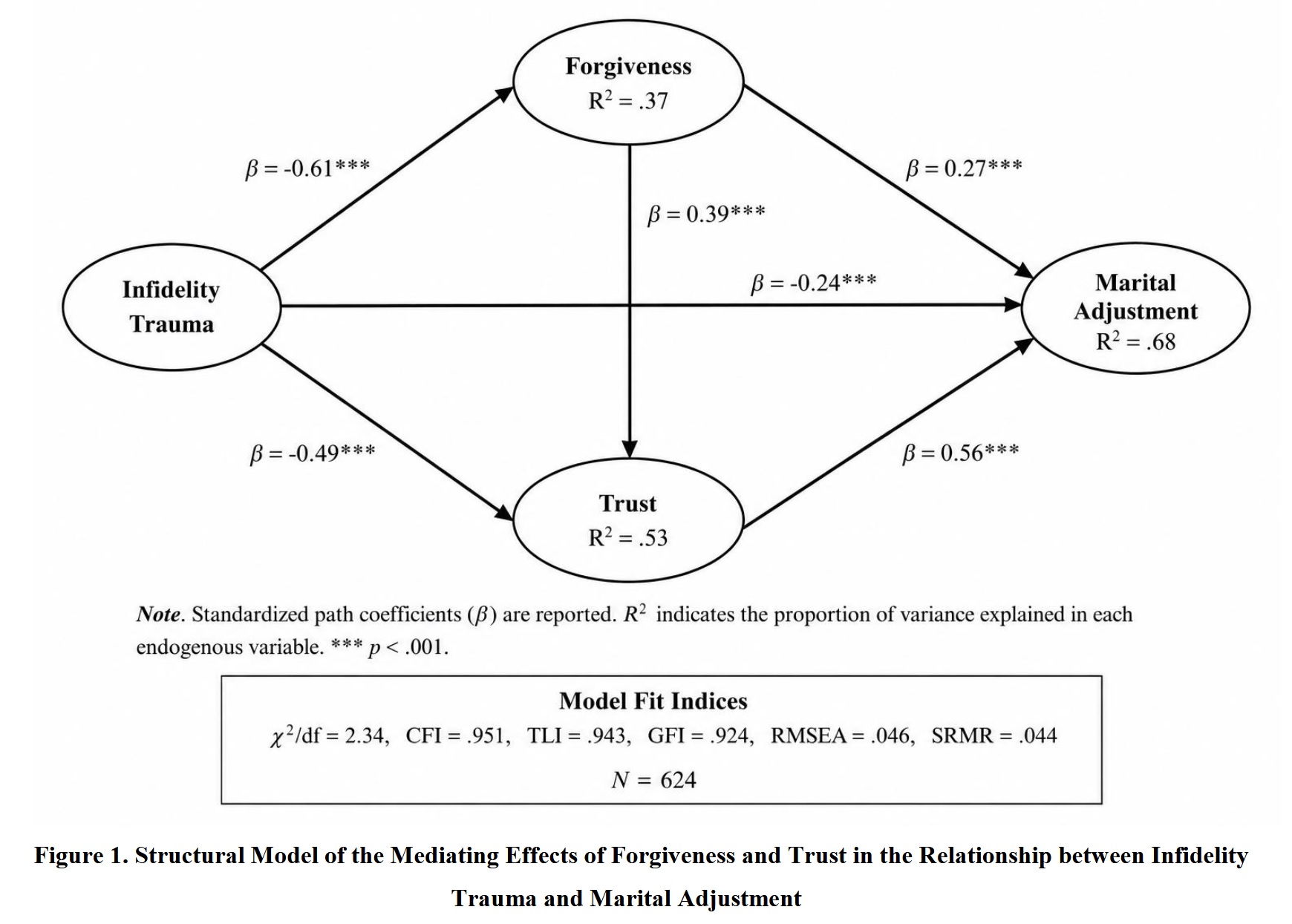
The present study aimed to examine the mediating roles of forgiveness and trust in the relationship between infidelity trauma and marital adjustment among married adults in the United States. This cross-sectional correlational study was conducted among 624 married adults in the United States who had experienced emotional and/or sexual infidelity by their spouse within the previous five years. Participants were recruited through online relationship-support communities, social media platforms, and community organizations. Data were collected using the Infidelity Trauma Scale, the Transgression-Related Interpersonal Motivations Inventory (TRIM-18), the Dyadic Trust Scale, and the Revised Dyadic Adjustment Scale. Structural equation modeling (SEM) was employed to examine the direct and indirect relationships among study variables. Confirmatory factor analysis was performed to evaluate the measurement model, and model fit was assessed using χ²/df, CFI, TLI, GFI, RMSEA, and SRMR indices. Indirect effects were tested using bias-corrected bootstrapping with 5,000 resamples and 95% confidence intervals. Structural equation modeling indicated that the proposed model demonstrated excellent fit to the data (χ²/df = 2.34, CFI = 0.951, TLI = 0.943, GFI = 0.924, RMSEA = 0.046, SRMR = 0.044). Infidelity trauma significantly predicted lower forgiveness (β = -0.61, p < .001), lower trust (β = -0.49, p < .001), and poorer marital adjustment (β = -0.24, p < .001). Forgiveness positively predicted trust (β = 0.39, p < .001) and marital adjustment (β = 0.27, p < .001), while trust emerged as the strongest predictor of marital adjustment (β = 0.56, p < .001). Bootstrap analyses revealed significant indirect effects through forgiveness (β = -0.16, 95% CI [-0.23, -0.10]), trust (β = -0.27, 95% CI [-0.36, -0.19]), and the sequential pathway of forgiveness and trust (β = -0.13, 95% CI [-0.18, -0.08]). The final model explained 68.4% of the variance in marital adjustment. The findings indicate that infidelity trauma undermines marital adjustment both directly and indirectly through diminished forgiveness and trust. Trust emerged as the most influential mechanism linking betrayal-related trauma to marital functioning, while forgiveness facilitated adjustment both independently and through its contribution to trust restoration. These results highlight the importance of targeting forgiveness and trust in therapeutic interventions designed to promote recovery and relationship resilience following marital infidelity.
Downloads
References
Alfaruqy, M. Z., & Indrawati, E. S. (2023). The Dynamics of Marital Relationship After Infidelity: Phenomenological Descriptive Analysis on Muslim Spouses. Inspira Indonesian Journal of Psychological Research, 4(1), 41-53. https://doi.org/10.32505/inspira.v4i1.6080
Beltrán-Morillas, A. M., Valor‐Segura, I., & Expósito, F. (2023). Unforgiveness in the Light of Sexual Infidelity: Anxious Attachment to the Partner and Personal Distress as Correlates. Psychological Reports, 128(5), 3457-3477. https://doi.org/10.1177/00332941231208395
Cornelius‐White, J. H. D., & Kanamori, Y. (2025). The Correlates and Effectiveness of Partner-Focused Prayer: A Meta-Analysis of Relational Health. Psychology of Religion and Spirituality, 17(2), 71-81. https://doi.org/10.1037/rel0000508
Côté, M., Dufour, M., & Tremblay, J. (2022). Integrative Couple Treatment for Pathological Gamblers With an Emphasis on Forgiveness Processes: A Case Study With Three Couples. Journal of marital and family therapy, 48(4), 1017-1039. https://doi.org/10.1111/jmft.12596
Dacka, M., Kulik, A., & Nowak, K. (2023). Determinants of Forgiveness After Experiencing Infidelity in a Marital Relationship. Kwartalnik Naukowy Fides et Ratio, 54(2), 44-57. https://doi.org/10.34766/fetr.v54i2.1185
Dew, J., Saxey, M. T., & Mettmann, A. (2022). Money Lies and Extramarital Ties: Predicting Separate and Joint Occurrences of Financial Deception and Extramarital Infidelity. Frontiers in psychology, 13. https://doi.org/10.3389/fpsyg.2022.1038169
Fife, S. T., Gossner, J., Theobald, A. C., Allen, E., Rivero, A., & Koehl, H. (2023). Couple Healing From Infidelity: A Grounded Theory Study. Journal of Social and Personal Relationships, 40(12), 3882-3905. https://doi.org/10.1177/02654075231177874
Gacinya, D. J. (2024). Determinants of Divorce in Rwanda: A Case Study of Kigali City. strategicjournals.com, 11(1). https://doi.org/10.61426/sjbcm.v11i1.2838
Ghadaki, M., & Darbani, S. A. (2024). The Effectiveness of Strength-Based Intervention on Attitude Toward Marital Infidelity and Sexual Self-Concept in Women With Marital Conflict. Aftj, 5(3), 84-91. https://doi.org/10.61838/kman.aftj.5.3.9
Giacobbi, M., & Lalot, F. (2025). Unpacking Trust Repair in Couples: A Systematic Literature Review. Journal of Family Therapy, 47(1). https://doi.org/10.1111/1467-6427.12483
Hajihasani, M. (2026). Retaliatory Marital Infidelity After Betrayal. European Journal of Psychology Open, 85(1), 29-37. https://doi.org/10.1024/2673-8627/a000089
Hoy, E. Q. W., & Oh, V. Y. S. (2024). The Consequences of Spousal Infidelity for Long-Term Chronic Health: A Two-Wave Longitudinal Analysis. Journal of Social and Personal Relationships, 41(12), 3720-3740. https://doi.org/10.1177/02654075241276713
Jules, B. N., O’Connor, V., & Langhinrichsen‐Rohling, J. (2023). Judgments of Event Centrality as Predictors of Post-Traumatic Growth and Post-Traumatic Stress After Infidelity: The Moderating Effect of Relationship Form. Trauma Care, 3(4), 237-250. https://doi.org/10.3390/traumacare3040021
Karadzhy, O. (2023). Coping Behaviour of Women in the Situation When Their Partner Cheated. Scientific Bulletin of Mukachevo State University Series “Pedagogy and Psychology”, 9(4), 18-26. https://doi.org/10.52534/msu-pp4.2023.18
Karimi, S., Doostdari, F., Lotfabadi, N. B., Yosefi, R., Soleymani, M., Kianimoghadam, A. S., & Safari, F. (2023). The Role of Early Maladaptive Schemas in Predicting Legitimacy, Seduction, Normalization, Sexuality, Social Background, and Sensation Seeking in Marital Infidelity. Practice in Clinical Psychology, 11(3), 249-258. https://doi.org/10.32598/jpcp.11.3.848.2
Kartik, & Malhotra, S. (2024). The Legal Implications of Adultery: A Comprehensive Analysis. International Journal for Multidisciplinary Research, 6(1). https://doi.org/10.36948/ijfmr.2024.v06i01.12726
Kasprzak, A. (2025). Forgiveness in Romantic Relationships: The Moderating Role of Differentiation of Self in the Relationship Between Offense Severity and Post‐Offense Distress. Family Process, 64(4). https://doi.org/10.1111/famp.70082
Keyhan, F., Ghanifar, M. H., & Ahi, Q. (2023). Comparing the Effectiveness of Emotion-Oriented Couple Therapy and Acceptance and Commitment-Based Couple Therapy on Cognitive Indicators (Experiential Avoidance and Emotion Regulation) in Couples Affected by Extramarital Relationships. Jayps, 4(3), 9-19. https://doi.org/10.61838/kman.jayps.4.3.2
Khaneghahi, S., Poorjanebollahi, M. F., Koroghli, M., & Karimi, M. (2024). Effectiveness of Acceptance and Commitment-Based Couple Therapy on Communication Patterns and Marital Infidelity in Married Individuals. Aftj, 5(2), 218-226. https://doi.org/10.61838/kman.aftj.5.2.24
Mairal, J. B., & Polanski, T. (2021). Infidelity Treatment From an Integrative Behavioral Couple Therapy Perspective: Explanatory Model and Intervention Strategies. Journal of marital and family therapy, 47(4), 909-924. https://doi.org/10.1111/jmft.12483
Mohamad, Z. S., Bakar, K. A. A., ucsiuniversity.edu.my, A. M. K., Sallehudin, F. U., & May, W. G. C. (2022). The Positive State and Positive Mindset in Building a Positive Relationship: A Review Paper. Malaysian Journal of Social Sciences and Humanities (MJSSH), 7(7), e001640. https://doi.org/10.47405/mjssh.v7i7.1640
Najibzadegan, A., Bahrainian, S. A., & Shahabizadeh, F. (2024). Efficacy of Acceptance and Commitment Therapy on Intimacy, Marital Forgiveness, and Marital Burnout in Women Affected by Extramarital Relationships. Aftj, 5(3), 102-112. https://doi.org/10.61838/kman.aftj.5.3.11
Nnaji, I. C., & Okoye, C. B. (2024). Women, Marriage and Betrayal of Trust in Selected Nigerian Dramas. The International Journal of Social Sciences and Humanities Invention, 11(6), 8201-8207. https://doi.org/10.18535/ijsshi/v11i06.05
Pramudito, A. A., & Minza, W. M. (2021). The Dynamics of Rebuilding Trust and Trustworthiness in Marital Relationship Post Infidelity Disclosure. Jurnal Psikologi, 48(2), 16. https://doi.org/10.22146/jpsi.60974
Rokach, A., & Chan, S. H. (2023). Love and Infidelity: Causes and Consequences. International journal of environmental research and public health, 20(5), 3904. https://doi.org/10.3390/ijerph20053904
Şahan, B. (2021). Does Forgiveness Affect Marital Satisfaction? Spiritual Psychology and Counseling, 83-108. https://doi.org/10.37898/spc.2021.6.3.146
Salehi, M., Abkenar, B. N., & Sarajari, M. Y. (2023). Effectiveness of Integrated Couples Therapy on Intimacy and Marital Forgiveness Among Women Affected by Extramarital Relationships. PWJ, 4(3), 69-76. https://doi.org/10.61838/kman.pwj.4.3.9
Salehzadeh, S., Bahram Ali Ghanbari Hashem, A., & Nejat, H. (2024). Structural Equation Modeling Modeling of the Tendency Toward Marital Infidelity Based on Significant Five Personality Factors Mediated by Attachment Styles and Sexual Satisfaction. Journal of Health Reports and Technology, 10(1). https://doi.org/10.5812/jhrt-142998
Sobhani, F. F., Shiroudi, S. G., & Khodabakhshi‐Koolaee, A. (2021). Effect of Two Couple Therapies, Acceptance and Commitment Therapy and Schema Therapy, on Forgiveness and Fear of Intimacy in Conflicting Couples. Practice in Clinical Psychology, 9(4), 271-282. https://doi.org/10.32598/jpcp.9.4.746.3
Stavrova, O., Pronk, T., & Denissen, J. J. A. (2022). Estranged and Unhappy? Examining the Dynamics of Personal and Relationship Well-Being Surrounding Infidelity. Psychological Science, 34(2), 143-169. https://doi.org/10.1177/09567976221116892
Tehrani, S. P., Morodi, S. G., & Rezazadeh, M. (2021). Emotional Charactristics of Personality, Cognitive Problems, Emotional Regulation Strategies and Marital Adjustment: A Comparative Study in Women With High and Low Fear of Infidility. The Journal of Psychological Science, 20(104), 1313-1329. https://doi.org/10.52547/jps.20.104.1313
Wondimu, S., & Andualem, T. (2024). Determinants of Marital Satisfaction From Married Individuals’ Perspectives in Addis Ababa: A Qualitative Study. International Journal of Qualitative Research, 3(3), 278-287. https://doi.org/10.47540/ijqr.v3i3.1297
Záhorcová, L., Dršťáková, Ž., & Masaryková, M. (2023). Forgiveness, Its Factors, and Unforgivable Acts in Romantic Relationships: A mixed‐methods Study. Personal Relationships, 30(2), 471-500. https://doi.org/10.1111/pere.12471

Downloads
Published
Submitted
Revised
Accepted
Issue
Section
License
Copyright (c) 2026 Rhian Kerton ; Jules Henrotte, Yvonne H. Chan (Author)

This work is licensed under a Creative Commons Attribution-NonCommercial 4.0 International License.