The Mediating Role of Dyadic Coping in the Relationship between Perceived Partner Responsiveness and Marital Satisfaction: A Structural Equation Modeling Study
Keywords:
Perceived Partner Responsiveness, Dyadic Coping, Marital Satisfaction, Structural Equation ModelingAbstract
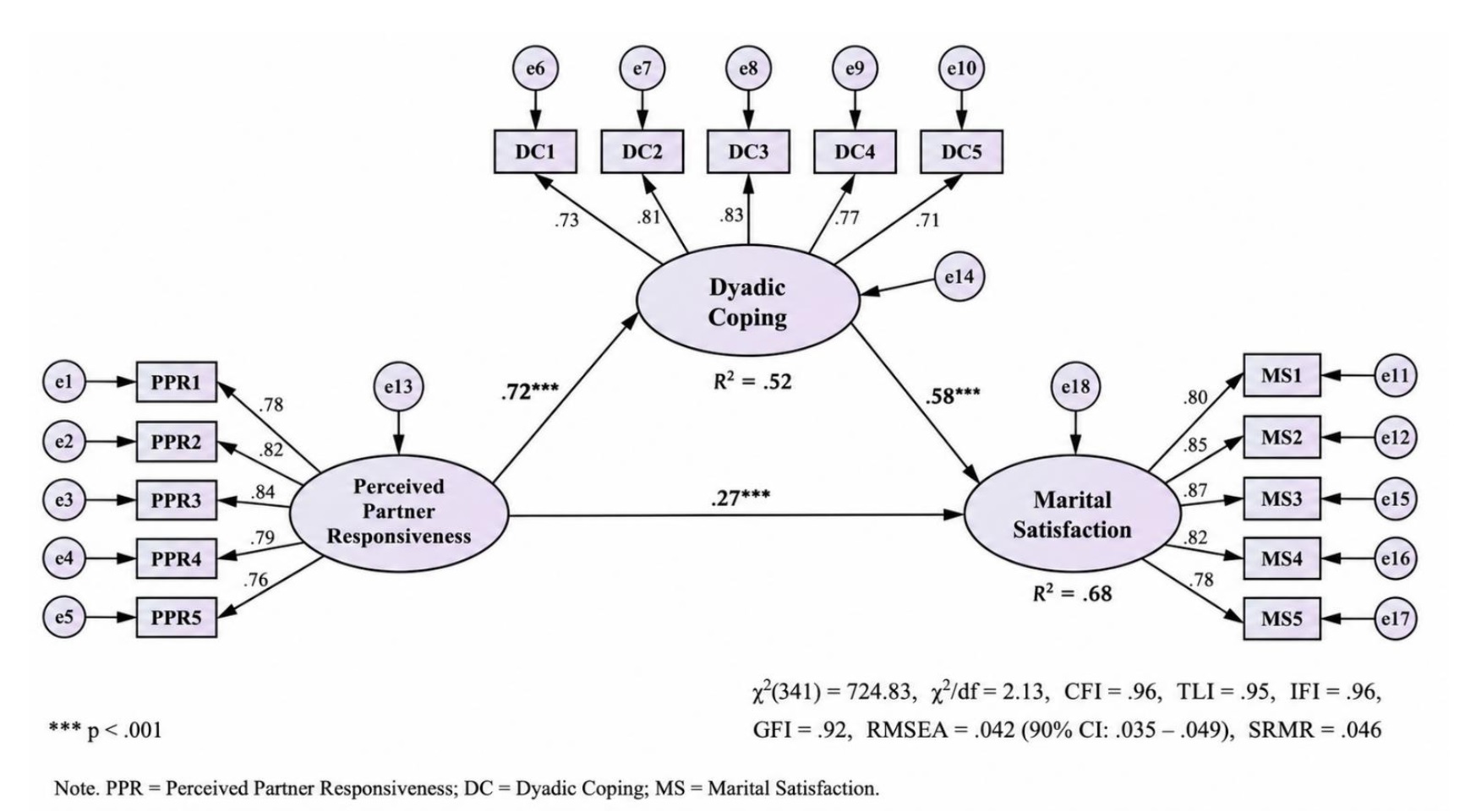
The present study aimed to examine the mediating role of dyadic coping in the relationship between perceived partner responsiveness and marital satisfaction among married adults in Canada using structural equation modeling. This cross-sectional correlational study was conducted among 642 married adults residing in various provinces of Canada. Participants were recruited through community organizations, counseling centers, and online platforms using voluntary participation procedures. Data were collected using the Perceived Partner Responsiveness Scale (PPRS), the Dyadic Coping Inventory (DCI), and the Couples Satisfaction Index (CSI-32). Descriptive statistics, Pearson correlation analyses, confirmatory factor analysis, and structural equation modeling were performed using SPSS 29 and AMOS 29. The measurement model was evaluated through multiple goodness-of-fit indices, and mediation effects were tested using bootstrap procedures with 5,000 resamples and bias-corrected confidence intervals. The results demonstrated significant positive associations among all study variables. Perceived partner responsiveness was positively associated with dyadic coping (β = 0.72, p < .001) and marital satisfaction (β = 0.27, p < .001). Dyadic coping was also positively associated with marital satisfaction (β = 0.58, p < .001). The structural model demonstrated excellent fit to the data (χ²/df = 2.13, CFI = .96, TLI = .95, IFI = .96, GFI = .92, RMSEA = .042, SRMR = .046). Bootstrap analyses indicated a significant indirect effect of perceived partner responsiveness on marital satisfaction through dyadic coping (β = 0.42, p < .001), confirming partial mediation. The final model explained 52% of the variance in dyadic coping and 68% of the variance in marital satisfaction, indicating substantial explanatory power. The findings indicate that perceived partner responsiveness contributes significantly to marital satisfaction both directly and indirectly through dyadic coping. Couples who perceive greater understanding, validation, and emotional support from their partners are more likely to engage in adaptive collaborative coping processes, which in turn enhance marital satisfaction. These results support contemporary relational theories emphasizing the importance of interpersonal responsiveness and dyadic adaptation in marital functioning and suggest that interventions targeting responsive communication and dyadic coping skills may promote healthier and more satisfying marital relationships.
Downloads
References
Alipour, S. M., Rahimzadeh, M., Tourzani, Z. M., Mahmoodi, Z., & Saeieh, S. E. (2023). Predictor Role of Marital Conflict on Maternal Competency With Mediating Role of Perceived Stress and Concerns During Pregnancy: A Structural Equation Model. Neuropsychopharmacology Reports, 43(1), 95-102. https://doi.org/10.1002/npr2.12309
Arsa, R., Meemon, N., Keetawattananon, W., Yenchai, D., Kiewnin, K., Pitong, P., Jangcharoenjittkul, K., & Waleewong, O. (2025). Personal Wellbeing and Depression Among Thai People Living in Poverty: Evidence From the COVID-19 Crisis. BMC public health, 25(1). https://doi.org/10.1186/s12889-025-25321-4
Berenguer-Soler, M., Castillo‐López, Á. G. d., & Pineda, D. (2023). Breaking the Cycle of Emotional Flooding: The Protective Role of Women’s Emotional Intelligence in Couple’s Conflict. Frontiers in psychology, 14. https://doi.org/10.3389/fpsyg.2023.1217513
Ekinci, B., & Canpolat, M. (2025). Romantic Relationship Satisfaction and Marriage Attitudes in Young Adults: The Mediating Role of Cognitive Flexibility. BMC psychology, 13(1). https://doi.org/10.1186/s40359-025-03901-8
Ferreira, S., Batista, P., Sánchez-Sáez, J. A., Sánchez‐Sánchez, J., & Carvalho, M. J. (2023). Road Racing Event Management Satisfaction: A Scoping Review of the Literature in Different Populations. Sustainability, 15(3), 2251. https://doi.org/10.3390/su15032251
Fivecoat, H. C., Mattson, R. E., Cameron, N. M., & Johnson, M. D. (2024). Social Support and Perceived Partner Responsiveness Have Complex Associations With Salivary Cortisol in Married Couples. Journal of Social and Personal Relationships, 41(7), 1913-1935. https://doi.org/10.1177/02654075241229755
Genç, E. (2026). The Impact of Obsessive‐Compulsive Relationship Symptoms on Marital Instability: Mediating Role of Infidelity Tendency. Journal of marital and family therapy, 52(2). https://doi.org/10.1111/jmft.70122
Gyeong, S. (2026). Divergent Network Pathways Linking Personality, Approach–avoidance Goals, and Marital Adjustment to Psychological Well-Being. Journal of Social and Personal Relationships. https://doi.org/10.1177/02654075261422436
Idulfilastri, R. M., Khaerunissa, M. R., & Zakaria, S. M. (2024). Harmonious Husband and Wife Relationship. Edunity Kajian Ilmu Sosial Dan Pendidikan, 3(1), 14-31. https://doi.org/10.57096/edunity.v3i1.208
Kim, S. (2026). The Two Faces of I‐Position: A Network Analysis of Self‐Differentiation and Marital Satisfaction in South Korea. Journal of marital and family therapy, 52(1). https://doi.org/10.1111/jmft.70115
Kim, S. Y., & Woo, S. (2025). Indirect Effects of Self‐Differentiation and Mentalization on Family of Origin Health and Marital Satisfaction Among Korean Adults. Journal of marital and family therapy, 51(1). https://doi.org/10.1111/jmft.12756
Körün, A. B., Satıcı, S. A., & Jones, A. C. (2026). Adaptation of the Couple Communication Satisfaction Scale to Turkish: Its Associations With Family Communication, Dyadic Trust, and Relationship Satisfaction. Journal of marital and family therapy, 52(1). https://doi.org/10.1111/jmft.70113
Kumar, R., & Singh, R. M. (2024). Couple Identity in Indian Arranged Marriages: Perceived Partner Responsiveness as the Mediator of Attachment Styles and Couple Identity. Couple and Family Psychology Research and Practice, 13(2), 143-155. https://doi.org/10.1037/cfp0000220
Li, X., Wikle, J. S., Schraedel, J. C., Yorgason, J. B., & James, S. (2022). Relational Communication as a Moderator for Links Between Family of Origin Adversity and Marital Satisfaction. Family Relations, 72(4), 1955-1973. https://doi.org/10.1111/fare.12808
Novianti, L. E., Purba, F. D., Karremans, J. C., & Agustiani, H. (2024). Financial Strain Among West-Javanese Parents: Its Association With Marital Satisfaction and Quality of Life, and the Role of Dyadic Coping. Frontiers in psychology, 15. https://doi.org/10.3389/fpsyg.2024.1434426
Park, C., & Harris, V. W. (2025a). The Association Between Mindfulness, Shared Relationship Activity Engagement, Connectedness, and Positive Interaction in Couple Relationships. Journal of marital and family therapy, 51(4). https://doi.org/10.1111/jmft.70081
Park, C., & Harris, V. W. (2025b). Consensus, Need Fulfillment, Commitment, and Satisfaction in Couple Relationships: Structural Equation Modeling. Journal of marital and family therapy, 51(1). https://doi.org/10.1111/jmft.70001
Ran, G., & Cinamon, R. G. (2022). Career Self-Efficacy, Future Perceptions, and Life Satisfaction: Investigating Two Adolescent Career Development Models. Journal of Career Development, 50(4), 764-784. https://doi.org/10.1177/08948453221124891
Ross, J., Nguyen, T. P., Karney, B. R., & Bradbury, T. N. (2022). Three Tests of the Vulnerability-Stress-Adaptation Model: Independent Prediction, Mediation, and Generalizability. Frontiers in psychology, 13. https://doi.org/10.3389/fpsyg.2022.921485
Seo, M. (2025). Communication and Couple Satisfaction of Women in Cross‐National Marriages and Korean Husbands: Mediating Effect of Intimacy. Journal of marital and family therapy, 52(1). https://doi.org/10.1111/jmft.70098
Shen, T., Weaver, S. E., & Britner, P. A. (2025). From Family of Origin to Romantic Relationships: A Cross-Cultural Exploration of Associations. Emerging Adulthood, 13(4), 932-946. https://doi.org/10.1177/21676968251337655
Shisanya, M. S., Kipmerewo, M., Morema, E., & Ouma, C. (2025). Assessing the Application of Adapted Theory of Planned Behaviour in Predicting Postpartum Family Planning Intentions in a Pragmatic Randomized Control Trial in Western Kenya. PLoS One, 20(2), e0315029. https://doi.org/10.1371/journal.pone.0315029
Sokar, S. (2024). Childhood Maltreatment and the Quality of Marital Relationships: Examining Mediating Pathways and Gender Differences. Journal of Social and Personal Relationships, 41(7), 1959-1979. https://doi.org/10.1177/02654075241232168
Sun, Y., & Wang, W. (2023). Research Into the Relative Influences of Spouses Doing Housework, Family Decision-Making, and Physical and Mental Health on Chinese Family Marital Satisfaction. SHS Web of Conferences, 154, 03008. https://doi.org/10.1051/shsconf/202315403008
Temiz, Z. T., & Elsharnouby, E. (2022). Relationship Satisfaction and Well-Being During the COVID-19 Pandemic: Examining the Associations With Interpersonal Emotion Regulation Strategies. Cognitive therapy and research, 46(5), 902-915. https://doi.org/10.1007/s10608-022-10317-w
Yuan, G. (2025). The Buffering Effect of Spousal Support in Later Life: Mediated and Moderated Pathways From Negative Life Events to Loneliness Among Older Adults. Frontiers in psychology, 16. https://doi.org/10.3389/fpsyg.2025.1698354

Downloads
Published
Submitted
Revised
Accepted
Issue
Section
License
Copyright (c) 2026 Marie-Eve Caplette ; Shuhui Pan (Author)

This work is licensed under a Creative Commons Attribution-NonCommercial 4.0 International License.