The Effectiveness of Emotionally Focused Couple Therapy on Attachment Injuries, Dyadic Trust, and Marital Forgiveness among Couples Experiencing Infidelity-Related Distress
Keywords:
Emotionally Focused Couple Therapy, Infidelity, Attachment Injuries, Dyadic Trust, Marital Forgiveness, Affair Recovery, Couple Therapy, Attachment TheoryAbstract
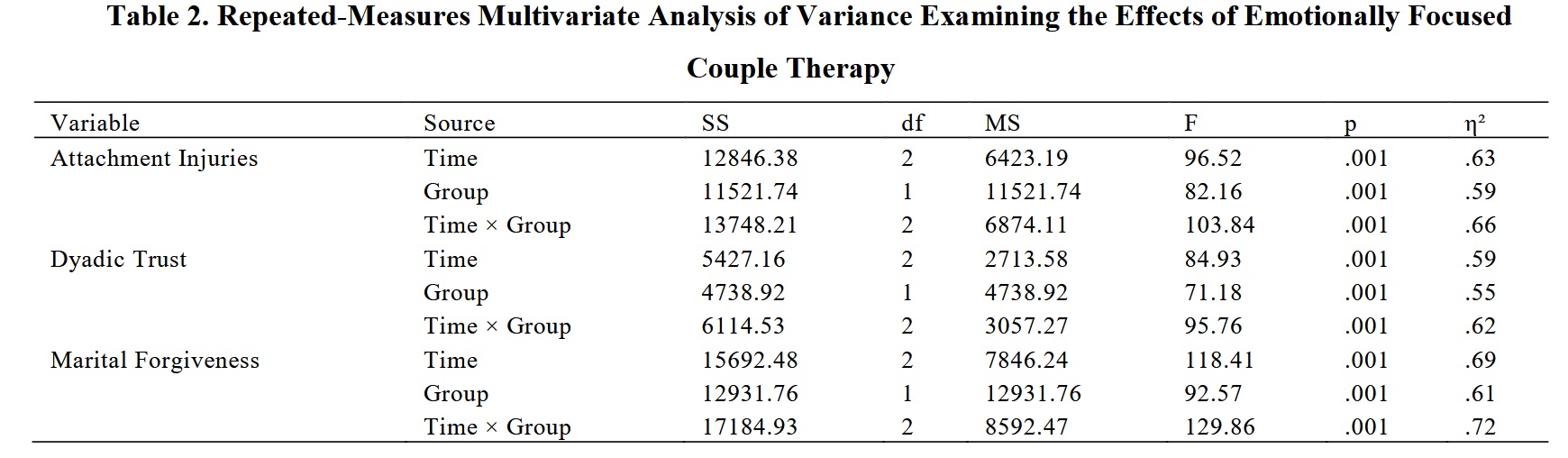
The present study aimed to investigate the effectiveness of Emotionally Focused Couple Therapy (EFCT) on attachment injuries, dyadic trust, and marital forgiveness among couples experiencing distress related to emotional or sexual infidelity. This study employed a quasi-experimental design with pretest, posttest, and three-month follow-up assessments using an experimental and a waitlist control group. The population consisted of couples seeking counseling services for infidelity-related relationship problems in Canada during 2025–2026. Following screening procedures, 60 couples (120 individuals) who met the inclusion criteria were selected and randomly assigned to either the experimental group (30 couples) or the control group (30 couples). Participants in the experimental group received twelve weekly 90-minute sessions of Emotionally Focused Couple Therapy, whereas the control group received no intervention during the study period. Data were collected using the Attachment Injury Resolution Scale, the Dyadic Trust Scale, and the Marital Forgiveness Scale. The data were analyzed using repeated-measures multivariate analysis of variance and Bonferroni post hoc comparisons in SPSS version 29. The results of repeated-measures multivariate analysis of variance revealed significant effects of time, group, and Time × Group interaction for all dependent variables. Significant interaction effects were found for attachment injuries (F = 103.84, p < .001, η² = .66), dyadic trust (F = 95.76, p < .001, η² = .62), and marital forgiveness (F = 129.86, p < .001, η² = .72), indicating that participants receiving EFCT experienced significantly greater improvements than those in the control group. Bonferroni pairwise comparisons demonstrated significant reductions in attachment injuries and significant increases in dyadic trust and marital forgiveness from pretest to posttest and from pretest to follow-up (p < .001). No significant differences were observed between posttest and follow-up scores, indicating maintenance of treatment gains across the follow-up period. The findings indicate that Emotionally Focused Couple Therapy is an effective intervention for couples experiencing infidelity-related distress. By addressing attachment-related vulnerabilities and promoting emotionally corrective interactions, EFCT significantly reduced attachment injuries while enhancing dyadic trust and marital forgiveness. The sustained improvements observed at follow-up suggest that the intervention facilitates enduring changes in relational functioning and supports long-term recovery following experiences of betrayal.
Downloads
References
Alexander. (2022). 52-Year-Old Man • Erectile Dysfunction • Insomnia • Migraine Headaches • Disclosure of Infidelity. 71(6). https://doi.org/10.12788/jfp.0438
Behrang, K., Koraei, A., Shahbazi, M., & Abbaspour, Z. (2022). Effects of Emotionally Focused Therapy on Sexual Assertiveness, Marital Forgiveness, and Marital Harmony in Maladjusted Couples. Journal of Research and Health, 12(3), 177-184. https://doi.org/10.32598/jrh.12.3.1986.1
Beltrán-Morillas, A. M., Valor‐Segura, I., & Expósito, F. (2023). Unforgiveness in the Light of Sexual Infidelity: Anxious Attachment to the Partner and Personal Distress as Correlates. Psychological Reports, 128(5), 3457-3477. https://doi.org/10.1177/00332941231208395
Clemente, M., & Espinosa, P. (2021). Revenge in Couple Relationships and Their Relation to the Dark Triad. International journal of environmental research and public health, 18(14), 7653. https://doi.org/10.3390/ijerph18147653
Crawford, M. D., Butler, M. H., Marks, L. D., & Leavitt, C. J. (2023). Married Women's Response to Spousal Pornography Use: A Grounded Theory. Journal of marital and family therapy, 50(1), 95-119. https://doi.org/10.1111/jmft.12672
Curtis, R., Likis‐Werle, E., & Shelton, T. L. (2021). Counseling Clients Who Have Experienced Undisclosed Infidelity. The Family Journal, 29(4), 457-464. https://doi.org/10.1177/10664807211005066
Davidar, R. S., Ballal, D., & Rajan, S. K. (2025). Treatment of Attachment Trauma: Effects of an Online EMDR Couple Protocol on Trauma Symptoms, Conflict Resolution, and Forgiveness. Counselling and Psychotherapy Research, 25(3). https://doi.org/10.1002/capr.70042
Fife, S. T., Gossner, J., Theobald, A. C., Allen, E., Rivero, A., & Koehl, H. (2023). Couple Healing From Infidelity: A Grounded Theory Study. Journal of Social and Personal Relationships, 40(12), 3882-3905. https://doi.org/10.1177/02654075231177874
Fife, S. T., Theobald, A. C., Gossner, J., Yakum, B. N., & White, K. L. (2022). Individual Healing From Infidelity and Breakup for Emerging Adults: A Grounded Theory. Journal of Social and Personal Relationships, 39(6), 1814-1838. https://doi.org/10.1177/02654075211067441
Giacobbi, M., & Lalot, F. (2025). Unpacking Trust Repair in Couples: A Systematic Literature Review. Journal of Family Therapy, 47(1). https://doi.org/10.1111/1467-6427.12483
Hashemizadeh, F. s., Atashpour, S. H., & Farhadi, H. (2023). Comparison of the Effectiveness of Paradoxical Timetable Cure (PTC), Acceptance and Commitment Therapy Matrix (ACTM), and Emotion-Focused Therapy (EFT) on Self-Esteem and Marital Boredom in Women With Marital Conflict. PWJ, 4(4), 27-38. https://doi.org/10.61838/kman.pwj.4.4.4
Jean, M., Brassard, A., Boon, S. D., Lafontaine, M. F., Mondor, J., & Péloquin, K. (2024). “I Did Not Expect That From You!”: Unforgiveness Dimensions, Attachment Insecurities, and Relationship Under‐commitment Following a Relational Transgression. Personal Relationships, 31(4), 1047-1066. https://doi.org/10.1111/pere.12568
Jules, B. N., O’Connor, V., & Langhinrichsen‐Rohling, J. (2023). Judgments of Event Centrality as Predictors of Post-Traumatic Growth and Post-Traumatic Stress After Infidelity: The Moderating Effect of Relationship Form. Trauma Care, 3(4), 237-250. https://doi.org/10.3390/traumacare3040021
Karadzhy, O. (2023). Coping Behaviour of Women in the Situation When Their Partner Cheated. Scientific Bulletin of Mukachevo State University Series “Pedagogy and Psychology”, 9(4), 18-26. https://doi.org/10.52534/msu-pp4.2023.18
Kasprzak, A. (2025). Forgiveness in Romantic Relationships: The Moderating Role of Differentiation of Self in the Relationship Between Offense Severity and Post‐Offense Distress. Family Process, 64(4). https://doi.org/10.1111/famp.70082
KeleŞ, F. B., KesİCİ, Ş., & Ak, M. (2022). A Psychological Perspective on Infidelity in the Context of a Literary Work: Anna Karenina-Lev Tolstoy. Research on Education and Psychology, 6(2), 254-267. https://doi.org/10.54535/rep.1213058
Khaneghahi, S., Poorjanebollahi, M. F., Koroghli, M., & Karimi, M. (2024). Effectiveness of Acceptance and Commitment-Based Couple Therapy on Communication Patterns and Marital Infidelity in Married Individuals. Aftj, 5(2), 218-226. https://doi.org/10.61838/kman.aftj.5.2.24
Mairal, J. B., & Polanski, T. (2021). Infidelity Treatment From an Integrative Behavioral Couple Therapy Perspective: Explanatory Model and Intervention Strategies. Journal of marital and family therapy, 47(4), 909-924. https://doi.org/10.1111/jmft.12483
Mitchell, E. A., Brown, K. S., Spencer, J., & Harris, K. (2025). Staying Together After Infidelity: An Exploration of the Decision‐Making Process of Recovery From the Perspective of the Injured Partner. Journal of marital and family therapy, 52(1). https://doi.org/10.1111/jmft.70110
Mitchell, E. A., Wittenborn, A. K., Timm, T. M., & Blow, A. J. (2021). Affair Recovery: Exploring Similarities and Differences of Injured and Involved Partners. Journal of marital and family therapy, 48(2), 447-463. https://doi.org/10.1111/jmft.12538
Najibzadegan, A., Bahrainian, S. A., & Shahabizadeh, F. (2024). Efficacy of Acceptance and Commitment Therapy on Intimacy, Marital Forgiveness, and Marital Burnout in Women Affected by Extramarital Relationships. Aftj, 5(3), 102-112. https://doi.org/10.61838/kman.aftj.5.3.11
Nezamalmolki, M., Bahrainian, S. A., & Shahabizadeh, F. (2023). Effectiveness of Emotion-Focused Couples Therapy on Sexual Function, Marital Intimacy, and Impulsivity in Women Affected by Marital Infidelity. PWJ, 4(4), 39-47. https://doi.org/10.61838/kman.pwj.4.4.5
Pasha, D., Hatamipour, K., & Nezhad, M. R. (2024). Effectiveness of Schema Therapy on Marital Relationship Quality and Emotion Regulation in Couples Affected by Infidelity. Jarac, 6(2), 71-78. https://doi.org/10.61838/kman.jarac.6.2.9
Puigvert, L., Campdepadrós, R., Barbany, J. M. C., & Yeste, C. G. (2022). Reducing Health Effects on Deceit in Heterosexual Sexual-Affective Relationships: The Impact of the Preventive Socialization Program (PSP). International journal of environmental research and public health, 19(4), 2274. https://doi.org/10.3390/ijerph19042274
Ripoll‐Núñez, K., & Gordon, K. C. (2024). Dealing With Couple Infidelity in Romantic Relationships: A Group Intervention Feasibility Study. Family Process, 63(4), 1907-1925. https://doi.org/10.1111/famp.13029
Rokach, A., & Chan, S. H. (2023). Love and Infidelity: Causes and Consequences. International journal of environmental research and public health, 20(5), 3904. https://doi.org/10.3390/ijerph20053904
Salehi, M., Abkenar, B. N., & Sarajari, M. Y. (2023). Effectiveness of Integrated Couples Therapy on Intimacy and Marital Forgiveness Among Women Affected by Extramarital Relationships. PWJ, 4(3), 69-76. https://doi.org/10.61838/kman.pwj.4.3.9
Shrestha, P. S., Shaver, S. R., Perlman, T. T., & Walsham, W. (2023). Emotional Dimensions of Infidelity: An Analysis of Psychological and Emotional Factors Affecting Relationship Infidelity. Jurnal Sosial Sains Terapan Dan Riset (Sosateris), 11(2), 88-103. https://doi.org/10.35335/85rbw180
Tadros, E., Gomez, E., & Dudek, M. (2022). Couple Connectedness in the Time of COVID-19. The Family Journal, 30(4), 589-595. https://doi.org/10.1177/10664807221082397
Torani, R. A., & Fard, M. S. (2024). Efficacy of Emotion-Focused Couple Therapy on Intimacy, Marital Adjustment, and Forgiveness Among Couples With a History of Extramarital Affairs. Aftj, 5(2), 95-102. https://doi.org/10.61838/kman.aftj.5.2.11
Walravens, G., & Rober, P. (2023). Relational Recovery After Infidelity as a Dual Process: A Model Based on the Experiences of Female Injured Partners. Family Process, 63(1), 151-162. https://doi.org/10.1111/famp.12857
Weiser, D. A., Shrout, M. R., Thomas, A. V., Edwards, A. L., & Cravens, J. D. (2022). “I’ve Been Cheated, Been Mistreated, When Will I Be Loved”: Two Decades of Infidelity Research Through an Intersectional Lens. Journal of Social and Personal Relationships, 40(3), 856-898. https://doi.org/10.1177/02654075221113032
Wilkinson, D., & Dunlop, W. L. (2020). Both Sides of the Story: Narratives of Romantic Infidelity. Personal Relationships, 28(1), 121-147. https://doi.org/10.1111/pere.12355
Yousefpouri, M., Zomorodi, S., & Bazzāziān, S. (2024). Effectiveness of Acceptance and Commitment-Based Couples Therapy on Attitudes Towards Marital Infidelity and Emotional Regulation in Married Women. Aftj, 5(2), 103-111. https://doi.org/10.61838/kman.aftj.5.2.12

Downloads
Published
Submitted
Revised
Accepted
Issue
Section
License
Copyright (c) 2026 Jonathan Chan ; Michał Gondje-Dacka (Author)

This work is licensed under a Creative Commons Attribution-NonCommercial 4.0 International License.