Predicting Work–Family Conflict and Marital Satisfaction Using Machine Learning: The Role of Job Stress, Emotional Exhaustion, Dyadic Coping, and Partner Support
Keywords:
Work–family conflict, marital satisfaction, machine learning, job stress, emotional exhaustion, dyadic coping, partner supportAbstract
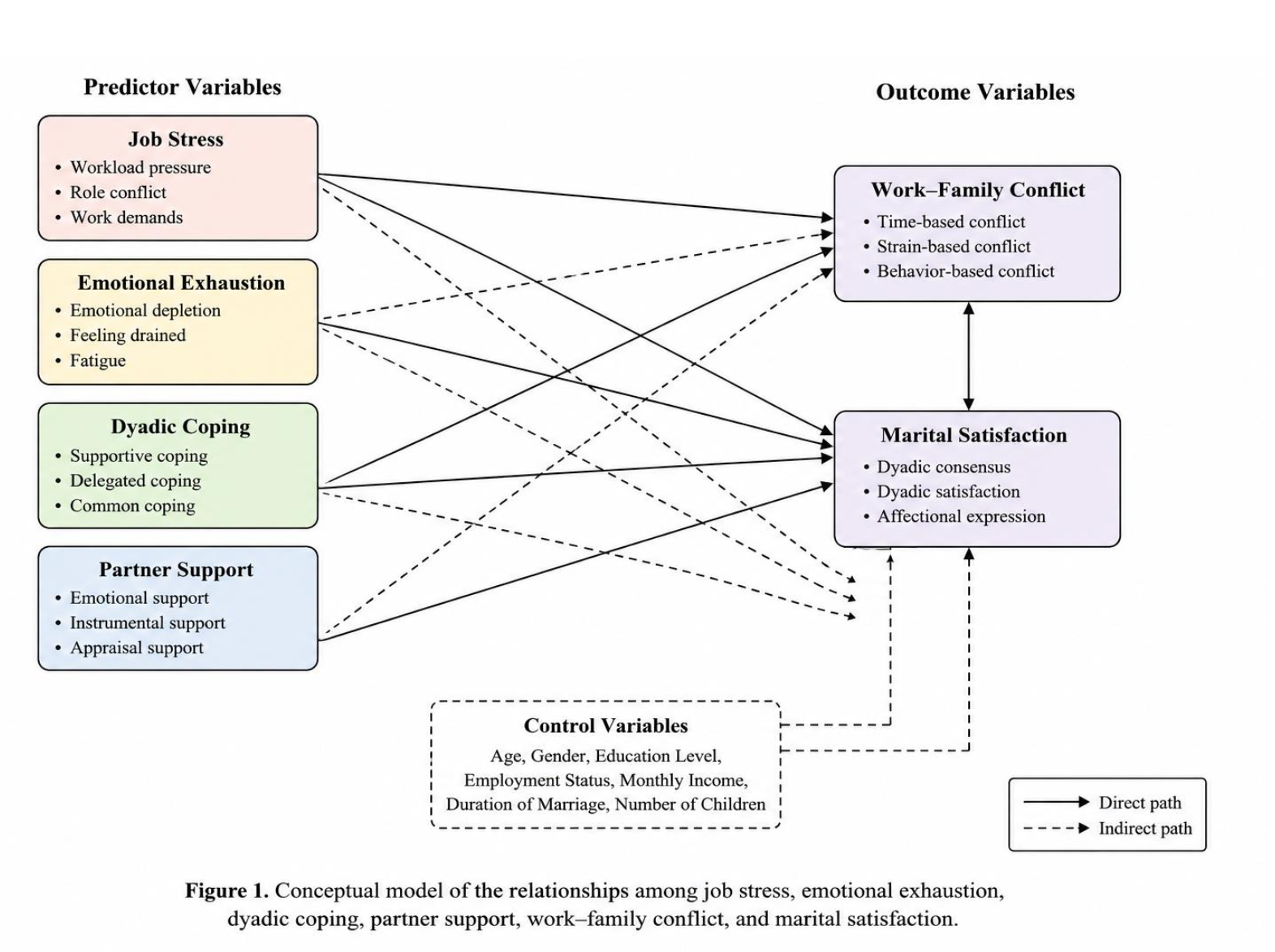
The present study aimed to predict work–family conflict and marital satisfaction among married employees using machine learning algorithms based on job stress, emotional exhaustion, dyadic coping, and partner support. This cross-sectional predictive study was conducted among 584 married employees recruited from governmental and private organizations in Tehran, Iran, through multistage cluster sampling. Participants completed the Work–Family Conflict Scale, Revised Dyadic Adjustment Scale, Job Stress Scale, Emotional Exhaustion subscale of the Maslach Burnout Inventory, Dyadic Coping Inventory, and Spousal Support Scale. Following data preprocessing, normalization, and missing-value treatment, the dataset was divided into training (80%) and testing (20%) subsets. Several machine learning algorithms, including Multiple Linear Regression, Support Vector Regression, Random Forest Regression, Gradient Boosting Regression, Artificial Neural Networks, and Extreme Gradient Boosting (XGBoost), were implemented. Model performance was evaluated using the coefficient of determination (R²), Root Mean Square Error (RMSE), Mean Absolute Error (MAE), and Mean Absolute Percentage Error (MAPE). Feature importance analyses were conducted using permutation importance and SHAP techniques. Correlation analyses revealed that work–family conflict was positively associated with job stress (r = 0.68, p < .001) and emotional exhaustion (r = 0.64, p < .001), while negatively associated with dyadic coping (r = -0.49, p < .001), partner support (r = -0.56, p < .001), and marital satisfaction (r = -0.62, p < .001). Marital satisfaction demonstrated significant positive relationships with dyadic coping (r = 0.73, p < .001) and partner support (r = 0.76, p < .001). Among all predictive models, XGBoost demonstrated the highest accuracy. The optimal model explained 81% of the variance in work–family conflict (R² = 0.81, RMSE = 5.14) and 84% of the variance in marital satisfaction (R² = 0.84, RMSE = 4.37). Feature importance analyses indicated that job stress and emotional exhaustion were the strongest predictors of work–family conflict, whereas partner support and dyadic coping emerged as the most influential predictors of marital satisfaction. The findings demonstrate that machine learning approaches can accurately predict work–family conflict and marital satisfaction using a combination of occupational and relational variables. Job stress and emotional exhaustion substantially increase vulnerability to work–family conflict, whereas dyadic coping and partner support function as powerful protective factors that enhance marital satisfaction. These results underscore the importance of strengthening both workplace well-being and couple-based coping resources to promote healthier marital relationships and better adaptation to work–family demands.
Downloads
References
Abreu-Afonso, J. d., Ramos, M. M., Garcia, I. Q., & Leal, I. (2021). How Couple’s Relationship Lasts Over Time? A Model for Marital Satisfaction. Psychological Reports, 125(3), 1601-1627. https://doi.org/10.1177/00332941211000651
Carrese‐Chacra, E., Hollett, K. B., Erdem, G., Miller, S., & Gouin, J. P. (2023). Longitudinal Effects of Pandemic Stressors and Dyadic Coping on Relationship Satisfaction During the COVID‐19 Pandemic. Family Relations, 72(3), 645-664. https://doi.org/10.1111/fare.12885
Chiș, R. (2022). A Critical Review of the Literature on the Relationships Between Personality Variables, Parenting and Marital Satisfaction. Postmodern Openings, 13(1), 17-46. https://doi.org/10.18662/po/13.1/383
Despax, J., Bouteyre, É., & Guiller, T. (2022). Psychological Profiles of Adoptees’ Partners and Their Representations of the Marital Relationship. Adoption & Fostering, 46(2), 134-150. https://doi.org/10.1177/03085759221092485
Hamedani, K. H., Majzoobi, M. R., & Forstmeier, S. (2024). The Relationship Between Perfectionism and Marital Outcomes: A Systematic Review and Meta-Analysis. Frontiers in psychology, 15. https://doi.org/10.3389/fpsyg.2024.1456902
He, B., Wongpakaran, T., Wongpakaran, N., & Wedding, D. (2022). Marital Satisfaction and Perceived Family Support in Families of Children With Autistic Spectrum Disorder: Dyadic Analysis. Healthcare, 10(7), 1227. https://doi.org/10.3390/healthcare10071227
Ijaz, I., Zubair, A., & Saeed, Q. (2022). Relationship Self-Regulation and Dyadic Coping in Married Women: Role of Demographic Factors. Pakistan Journal of Psychological Research, 37(1), 119-133. https://doi.org/10.33824/pjpr.2022.37.1.08
Indumathy, J., & Kanth, D. B. (2021). Communication Pattern, Dyadic Adjustment, and Parenting Practices Among Married Couples in India: Mediating Role of Dyadic Coping. Journal of Family Issues, 43(4), 894-922. https://doi.org/10.1177/0192513x21995873
Jiménez‐Picón, N., Romero‐Martín, M., Ramírez‐Baena, L., Palomo-Lara, J. C., & Gómez‐Salgado, J. (2021). Systematic Review of the Relationship Between Couple Dyadic Adjustment and Family Health. Children, 8(6), 491. https://doi.org/10.3390/children8060491
Junyan, G. L., Tan, K., Tan, M., Cheong, G., Cheng, C., & Mathew, M. (2023). Dyadic Positive and Negative Religious Coping Among Older Singaporean Couples and Marital Satisfaction. Journal of Family Psychology, 37(2), 268-274. https://doi.org/10.1037/fam0001025
Kurt, İ. E., & Sanberk, İ. (2022). COVID-19 Stress in Married Individuals in Terms of Dyadic Coping and Problem-Solving in Marriage. Türk Psikolojik Danışma Ve Rehberlik Dergisi, 12(67), 687-704. https://doi.org/10.17066/tpdrd.122510810
Li, Q., Xun, M., Chen, Z., Li, Y., Zhao, C., Ju, X., Lan, J., & Fang, X. (2023). Bidirectional or Unidirectional? Longitudinal Associations Between External Stressors, Perceived Spousal Support, and Marital Instability. Family Process, 63(3), 1185-1200. https://doi.org/10.1111/famp.12898
Mangialavori, S., Cacioppo, M., Terrone, G., & O’Hara, M. W. (2021). A Dyadic Approach to Stress and Prenatal Depression in First‐time Parents: The Mediating Role of Marital Satisfaction. Stress and Health, 37(4), 755-765. https://doi.org/10.1002/smi.3036
Novianti, L. E., Purba, F. D., Karremans, J. C., & Agustiani, H. (2024). Financial Strain Among West-Javanese Parents: Its Association With Marital Satisfaction and Quality of Life, and the Role of Dyadic Coping. Frontiers in psychology, 15. https://doi.org/10.3389/fpsyg.2024.1434426
Ouellet‐Courtois, C., Gravel, C., & Gouin, J. P. (2022). A Longitudinal Study of “We‐talk” as a Predictor of Marital Satisfaction. Personal Relationships, 30(1), 314-331. https://doi.org/10.1111/pere.12463
Pavon, M. V., Jakab, A. W., & Löw, A. (2024). Exploring Relationship Satisfaction in Mothers of Children With Disabilities: The Predictive Role of Interparental Conflicts and Moderating Role of Dyadic Coping. Frontiers in Psychiatry, 14. https://doi.org/10.3389/fpsyt.2023.1307827
Pereira, M. G., Bernardo, A. C., Silva, M., & Almeida, A. C. (2025). Marital Adjustment and Quality of Life in Fibromyalgia. Families Systems & Health, 43(2), 195-209. https://doi.org/10.1037/fsh0000962
Relvas, A. P., Lacomba‐Trejo, L., Portugal, A., Chiarolanza, C., Major, S., Rosa, C., Sotero, L., & Randall, A. K. (2023). YES, WE COPE: Dyadic Coping as a Mediator Between Perceived Relationship Quality and Emotional Representation of COVID-19. Cognitive therapy and research, 47(4), 563-573. https://doi.org/10.1007/s10608-023-10379-4
Santamaría‐Gutiez, R., Martínez‐Corredor, S., González‐Sala, F., & Lacomba‐Trejo, L. (2025). Relevance of Positive Dyadic Coping for Couples Undergoing Assisted Reproduction Treatments: A Systematic Review. Journal of marital and family therapy, 51(2). https://doi.org/10.1111/jmft.70016
Sentieiro, M. L., Ferreira, L. C., Miranda, M. P., & Vitória, B. A. (2025). Couples and Parenting Dynamics During Covid-19 Pandemic: A Systematic Review of the Literature. PLoS One, 20(2), e0315417. https://doi.org/10.1371/journal.pone.0315417
Simon‐Zámbori, P., Martos, T., Simon, T., & Sallay, V. (2025). Patterns of Bonding and Coping in Couples Raising Children With Atypical and Typical Development. Family Relations. https://doi.org/10.1111/fare.70035
Skinner, A. T., Gurdal, S., Chang, L., Oburu, P., & Tapanya, S. (2021). Dyadic Coping, Parental Warmth, and Adolescent Externalizing Behavior in Four Countries. Journal of Family Issues, 43(1), 237-258. https://doi.org/10.1177/0192513x21993851
Song, X. C., Zhao, J., Xiao, Z., Ye, H., Dong, S., Hu, L., & Cai, Z. (2024). The Actor‐partner Interdependence Model of Fertility Stress and Marital Quality Among Couples Undergoing in Vitro Fertilization and Embryo Transfer: The Mediating Role of Dyadic Coping. Stress and Health, 40(6). https://doi.org/10.1002/smi.3483
Surijah, E. A., Murray, K., & Shochet, I. M. (2025). The Compensatory Model of Resilience Process of Indonesian Married Individuals. Journal of marriage and family, 88(1), 299-310. https://doi.org/10.1111/jomf.70016
Surijah, E. A., Murray, K., Wraith, D., & Shochet, I. M. (2023). Examining Trajectories of Marital Satisfaction to Represent the Resilience Process Among Indonesian Married Individuals. Personal Relationships, 31(1), 24-43. https://doi.org/10.1111/pere.12529
Tan, K., Jarnecke, A. M., & South, S. C. (2023). Social Anhedonia, Communication, and Marital Satisfaction in Newlywed Couples. Journal of personality, 91(5), 1239-1252. https://doi.org/10.1111/jopy.12798
Turliuc, M. N., & Candel, O. S. (2021). Not All in the Same Boat. Socioeconomic Differences in Marital Stress and Satisfaction During the Covid-19 Pandemic. Frontiers in psychology, 12. https://doi.org/10.3389/fpsyg.2021.635148
Wells, J. L., Haase, C. M., Rothwell, E. S., Naugle, K. G., Otero, M. C., Brown, C. L., Lai, J., Chen, K. H., Connelly, D. E., Grimm, K. J., Levenson, R. W., & Fredrickson, B. L. (2022). Positivity Resonance in Long-Term Married Couples: Multimodal Characteristics and Consequences for Health and Longevity. Journal of personality and social psychology, 123(5), 983-1003. https://doi.org/10.1037/pspi0000385
Wendołowska, A., Steć, M., & Czyżowska, D. (2022). Supportive, Delegated, and Common Dyadic Coping Mediates the Association Between Adult Attachment Representation and Relationship Satisfaction: A Dyadic Approach. International journal of environmental research and public health, 19(13), 8026. https://doi.org/10.3390/ijerph19138026
Wiener, L., Bedoya, S. Z., Goyal, A., Gordon, M., Deuitch, N., & Widemann, B. C. (2023). The Perceived Influence of Neurofibromatosis Type 1(NF1) on the Parents’ Relationship. Children, 10(3), 448. https://doi.org/10.3390/children10030448
Xie, B., Ma, D., Feng, J., Sun, X., Ouyang, Y.-Q., & Xu, Y. (2025). Influences of Parental Intimacy and Self-Disclosure on Dyadic Coping Among Parents Raising School-Aged Children Diagnosed With Autism Spectrum Disorder. Journal of Family Medicine and Primary Care, 14(7), 2774-2781. https://doi.org/10.4103/jfmpc.jfmpc_1875_24
Zamir, O. (2021). Childhood Maltreatment and Relationship Quality: A Review of Type of Abuse and Mediating and Protective Factors. Trauma Violence & Abuse, 23(4), 1344-1357. https://doi.org/10.1177/1524838021998319
Zhao, X., Prandstetter, K., & Foran, H. M. (2021). Using Dyadic Modeling in Nursing Research: Introduction of Theory and Application. Western Journal of Nursing Research, 44(8), 788-798. https://doi.org/10.1177/01939459211016486

Downloads
Published
Submitted
Revised
Accepted
Issue
Section
License
Copyright (c) 2026 Kamdin Parsakia (Author); Seyed Hadi Seyed Alitabar

This work is licensed under a Creative Commons Attribution-NonCommercial 4.0 International License.