Emerging Directions in Couple Therapy Research: From Evidence-Based Interventions to Digital and Culturally Responsive Practice
Couple therapy has entered a period of substantial conceptual and methodological development. Once dominated by a relatively limited number of face-to-face therapeutic models, the field now encompasses evidence-based relational interventions, transdiagnostic approaches, digital delivery systems, culturally responsive frameworks, and increasingly sophisticated methods of assessment and outcome evaluation. These developments reflect broader changes in family structure, communication patterns, social expectations, technology use, and understandings of psychological well-being (Taee et al., 2025; Zhao et al., 2025). As couple relationships become embedded in increasingly complex social and digital environments, research must move beyond the question of whether couple therapy works and toward a more differentiated investigation of what works, for whom, under what conditions, and through which mechanisms.
One of the most important foundations of contemporary couple therapy remains the continued development and evaluation of evidence-based interventions. Research has increasingly emphasized the need for theoretically coherent treatments supported by systematic empirical assessment rather than reliance on clinical intuition alone. Intervention studies addressing marital satisfaction, intimacy, communication, conflict management, emotional regulation, attachment, and relational resilience have contributed to a more cumulative science of couple therapy (Rajaei & Sahebi, 2021; Smyth & Katz, 2021). At the same time, the growing diversity of therapeutic models indicates that no single approach is likely to be optimal for every couple. Comparative effectiveness research is therefore becoming increasingly important, particularly research examining mechanisms of therapeutic change rather than merely pre-treatment and post-treatment differences.
A related direction concerns the integration of individual psychological processes into relational formulations. Couple distress rarely develops independently of emotion regulation, cognitive patterns, attachment insecurity, trauma histories, personality characteristics, stress exposure, or broader mental health difficulties. Recent research increasingly recognizes that couple therapy must address the reciprocal influence between individual functioning and dyadic processes (McKee et al., 2023; Rahmati & Kermani Baghestani, 2024). This movement encourages researchers to examine not only relationship satisfaction as a global outcome but also specific pathways through which interventions influence emotional responsiveness, empathy, trust, forgiveness, conflict escalation, sexual and emotional intimacy, and adaptive communication.
The expansion of digital mental health represents another major frontier. Teletherapy, videoconference-based counseling, online psychoeducational programs, mobile applications, digital self-monitoring tools, artificial intelligence-supported communication systems, and blended therapeutic models are altering how relational interventions can be delivered. Digital platforms may reduce geographic and logistical barriers, facilitate continuity of care, and extend access to couples who would otherwise be unable or unwilling to attend conventional services (Wang, 2024; Zhao et al., 2025). However, digital delivery should not be treated merely as a technological replication of in-person therapy. It creates distinctive clinical and ethical questions involving privacy, therapeutic alliance, digital literacy, crisis management, engagement, data protection, and the interpretation of relational behavior mediated through technology.
Artificial intelligence is likely to intensify this transformation. Emerging systems may assist with screening, psychoeducation, progress monitoring, conversational analysis, personalized therapeutic exercises, and early identification of problematic interaction patterns. Yet the incorporation of artificial intelligence into couple therapy requires rigorous evaluation rather than technological enthusiasm. Researchers must investigate validity, bias, transparency, confidentiality, clinical accountability, and the possibility that algorithmic systems may fail to understand relational nuance or culturally embedded meanings (Mutluer et al., 2026; Spytska, 2025). The most productive research agenda will therefore examine how technological tools can augment—not replace—the expertise, ethical judgment, contextual understanding, and relational sensitivity of trained therapists.
Cultural responsiveness constitutes an equally important direction. Much of the established literature in psychotherapy has historically emerged from specific cultural contexts, while assumptions concerning marriage, intimacy, gender roles, parenting, family boundaries, emotional expression, and conflict resolution vary considerably across societies. Couple therapy research must therefore avoid treating relational norms developed in one cultural context as universal standards. Culturally responsive practice requires attention to values, religion, extended family systems, migration, socioeconomic conditions, gender expectations, language, community norms, and culturally specific understandings of marital responsibility and well-being (Atapour & Darbani, 2024; Jahandehideh & Ehlalzehi, 2024). Adaptation should go beyond translating intervention manuals; it should involve examining whether therapeutic goals, concepts, techniques, and measures have equivalent meanings across populations.
The field must also expand its understanding of diversity within couples. Contemporary couple therapy research should be sufficiently flexible to address differences in age, duration of relationship, family life cycle, infertility, chronic illness, disability, remarriage, migration, financial strain, caregiving, work-family conflict, and other contexts that shape relational functioning. Studies of couples exposed to major stressors are particularly valuable because such circumstances often reveal how individual vulnerability, dyadic coping, and social context interact. Research emphasizing resilience and relational strengths, rather than exclusively pathology and dysfunction, may further enrich intervention design (Rostami et al., 2025; Taee et al., 2025).
Methodological innovation will be essential to these emerging directions. Traditional randomized and quasi-experimental studies remain indispensable, but future work should increasingly incorporate longitudinal designs, intensive repeated measurement, dyadic data analysis, ecological momentary assessment, mediation and moderation models, qualitative inquiry, and mixed-method research. Because partners' experiences are interdependent, analytical strategies that treat individuals as statistically independent may obscure important relational mechanisms. More attention should therefore be given to actor-partner effects, reciprocal influence, within-couple variability, treatment trajectories, and therapist-level factors. Similarly, the field needs studies that move beyond statistical significance to examine clinically meaningful change, durability of outcomes, treatment adherence, dropout, accessibility, acceptability, and cost-effectiveness (Wagner & Schwind, 2025).
Another priority is the translation of research into routine clinical practice. The existence of an efficacious intervention does not guarantee its successful implementation in community clinics, counseling centers, hospitals, or private practice. Therapists work with couples presenting multiple simultaneous concerns, limited resources, varying readiness for change, and complex cultural and family environments. Implementation research can therefore help identify the training, supervision, organizational support, technological infrastructure, and adaptation processes necessary to preserve treatment integrity while allowing appropriate clinical flexibility. Closing the gap between research settings and everyday practice should become a central objective of the next generation of couple therapy scholarship.
Ultimately, the future of couple therapy research will be shaped by integration. Evidence-based intervention, cultural sensitivity, digital innovation, methodological rigor, and implementation science should not develop as isolated domains. The most influential research will connect these areas and examine relationships as dynamic systems embedded simultaneously in psychological, interpersonal, cultural, socioeconomic, and technological contexts. Such a perspective can help the field develop interventions that are not only effective under controlled conditions but also accessible, ethical, personalized, culturally meaningful, and sustainable in real-world settings.
In recognition of these emerging priorities, we invite researchers, clinicians, and interdisciplinary scholars to submit original manuscripts for the final issue of 2026, with particular emphasis on “Emerging Directions in Couple Therapy Research: From Evidence-Based Interventions to Digital and Culturally Responsive Practice.” We welcome empirical studies, randomized and quasi-experimental trials, systematic reviews and meta-analyses, qualitative and mixed-method investigations, methodological papers, and theoretically grounded clinical research.
Submissions addressing evidence-based couple interventions, mechanisms of therapeutic change, comparative treatment effectiveness, attachment and emotion regulation, communication and intimacy, teletherapy and digital interventions, artificial intelligence in relational care, culturally adapted couple therapy, dyadic assessment and analysis, diverse couple populations, implementation science, therapist training, and innovative models of prevention and intervention are particularly encouraged.
This special thematic focus seeks to bring together scholarship that can advance couple therapy beyond conventional boundaries and strengthen its scientific, technological, and cultural relevance. Authors whose work contributes to a more precise, accessible, inclusive, and evidence-informed understanding of couple relationships are warmly encouraged to submit their manuscripts for consideration in the last issue of 2026.
The Structural Association between Perceived Stress, Dyadic Coping, Relationship Commitment, and Marital Resilience
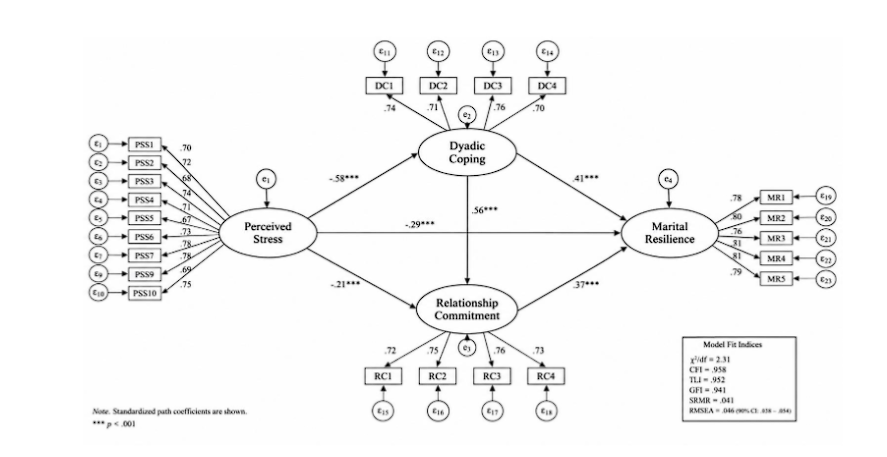
The present study aimed to examine the structural association between perceived stress, dyadic coping, relationship commitment, and marital resilience among married individuals in Baku, with particular emphasis on the direct and indirect pathways through which perceived stress influences marital resilience. This cross-sectional correlational study was conducted using structural equation modeling (SEM). The study population consisted of married individuals residing in Baku, Azerbaijan, during the 2025–2026 period. A total of 624 participants were selected through community-based and convenience sampling methods. Data were collected using the Perceived Stress Scale (PSS-10), Dyadic Coping Inventory (DCI), Commitment Inventory, and Marital Resilience Scale. Descriptive statistics, Pearson correlation analyses, confirmatory factor analysis, and structural equation modeling were performed using SPSS version 29 and AMOS version 29. Model fit was evaluated using multiple fit indices, including χ²/df, CFI, TLI, GFI, SRMR, and RMSEA. Indirect effects were tested using bootstrap procedures with 5,000 resamples and 95% confidence intervals. The proposed structural model demonstrated excellent fit to the data (χ²/df = 2.31, CFI = .958, TLI = .952, GFI = .941, SRMR = .041, RMSEA = .046). Perceived stress had significant negative direct effects on dyadic coping (β = -0.58, p < .001), relationship commitment (β = -0.21, p < .001), and marital resilience (β = -0.29, p < .001). Dyadic coping exerted significant positive effects on relationship commitment (β = 0.56, p < .001) and marital resilience (β = 0.41, p < .001). Relationship commitment also positively predicted marital resilience (β = 0.37, p < .001). Bootstrap analyses revealed significant indirect effects of perceived stress on marital resilience through dyadic coping (β = -0.24, p < .001), relationship commitment (β = -0.08, p < .001), and the sequential pathway involving dyadic coping and relationship commitment (β = -0.12, p < .001). The model explained 34% of the variance in dyadic coping, 46% of the variance in relationship commitment, and 71% of the variance in marital resilience. The findings indicate that perceived stress undermines marital resilience both directly and indirectly by weakening dyadic coping and relationship commitment. Dyadic coping emerged as a central protective factor that strengthens commitment and enhances resilience within marriage. These results highlight the importance of collaborative coping processes and relational dedication in fostering adaptive functioning among couples and suggest that interventions targeting stress management, dyadic coping, and commitment may contribute substantially to the promotion of marital resilience.
Predicting Marital Forgiveness after Infidelity Using Explainable Artificial Intelligence and Relational Trauma Indicators
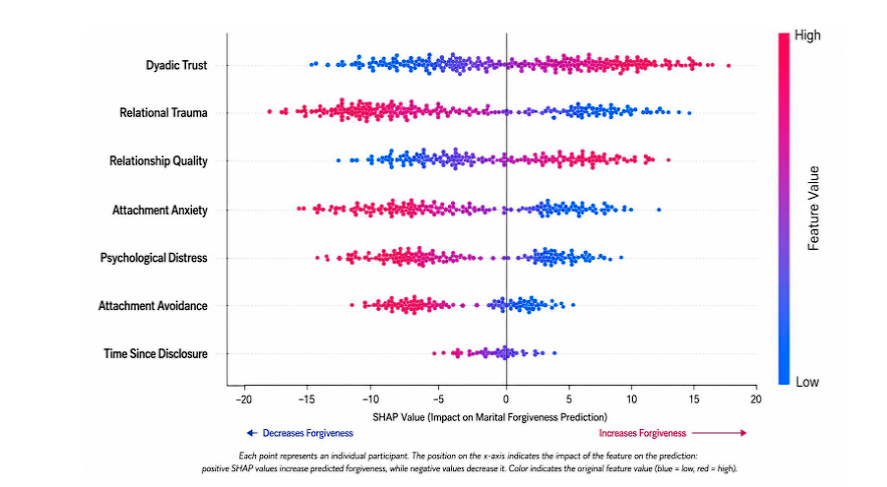
The present study aimed to predict marital forgiveness following infidelity using explainable artificial intelligence models and relational trauma indicators while identifying the relative importance of trust, attachment insecurity, psychological distress, and relationship quality in determining forgiveness outcomes among married individuals affected by extramarital relationships. This cross-sectional predictive study was conducted among 548 married individuals in Turkey who had experienced emotional, sexual, or combined forms of partner infidelity and remained in their relationships following disclosure. Participants were recruited from counseling centers, family therapy clinics, and online support networks. Data were collected using standardized measures of marital forgiveness, relational trauma, attachment insecurity, psychological distress, dyadic trust, and relationship quality. Several machine learning algorithms, including Elastic Net Regression, Support Vector Regression, Random Forest Regression, LightGBM, and Extreme Gradient Boosting (XGBoost), were developed and evaluated. Model performance was assessed using the coefficient of determination (R²), root mean square error (RMSE), mean absolute error (MAE), and mean absolute percentage error (MAPE). Explainable Artificial Intelligence techniques based on Shapley Additive Explanations (SHAP) were employed to identify and interpret the relative contribution of each predictor variable to forgiveness outcomes. Correlation analyses indicated that marital forgiveness was significantly and negatively associated with relational trauma, attachment anxiety, attachment avoidance, and psychological distress, while showing significant positive relationships with dyadic trust and relationship quality (p < .01). Among the evaluated machine learning algorithms, the XGBoost model demonstrated the highest predictive performance, explaining 84% of the variance in marital forgiveness (R² = .84), followed by LightGBM (R² = .81) and Random Forest Regression (R² = .78). SHAP analyses revealed that dyadic trust was the strongest predictor of forgiveness, followed by relational trauma, relationship quality, attachment anxiety, psychological distress, attachment avoidance, and time since disclosure. Cross-validation analyses confirmed the stability and robustness of the final model, with R² values consistently ranging between .83 and .85 across validation folds. The findings demonstrate that marital forgiveness following infidelity can be accurately predicted through explainable artificial intelligence models that integrate relational trauma indicators and psychological relationship variables. Trust restoration and trauma recovery emerged as the most influential determinants of forgiveness, highlighting the importance of trauma-informed and attachment-focused interventions in couples recovering from betrayal. The application of explainable artificial intelligence not only improved predictive accuracy but also enhanced understanding of the mechanisms underlying forgiveness after infidelity, offering valuable implications for assessment, treatment planning, and the development of personalized therapeutic approaches for distressed couples.
A Structural Equation Model of Family-of-Origin Experiences, Relationship Beliefs, Communication Patterns, and Couple Satisfaction
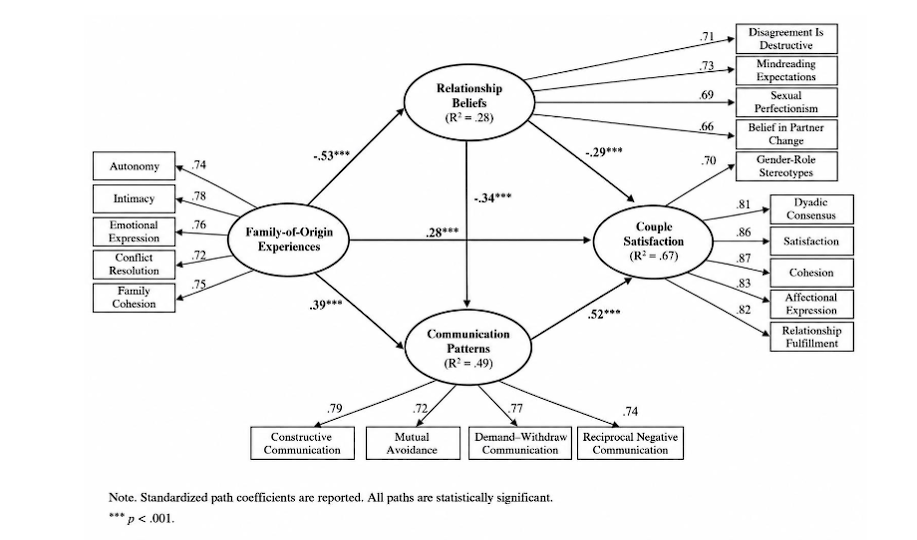
The present study aimed to examine a structural equation model investigating the direct and indirect relationships among family-of-origin experiences, relationship beliefs, communication patterns, and couple satisfaction among adults in the United States. This cross-sectional correlational study was conducted among 618 adults (309 couples) residing in the United States who were involved in committed romantic relationships. Participants were recruited through community organizations, counseling centers, social media platforms, and online survey panels. Data were collected using the Family-of-Origin Scale (FOS), Relationship Belief Inventory (RBI), Communication Patterns Questionnaire–Short Form (CPQ-SF), and Couple Satisfaction Index (CSI-32). Descriptive statistics, Pearson correlation analyses, confirmatory factor analysis, and structural equation modeling were performed using SPSS 29 and AMOS 29. Model fit was evaluated using χ²/df, CFI, TLI, GFI, AGFI, RMSEA, and SRMR indices. Bootstrapping with 5,000 resamples was employed to assess indirect effects and mediation pathways. Correlation analyses revealed significant associations among all study variables. Family-of-origin experiences were negatively associated with dysfunctional relationship beliefs and positively associated with communication patterns and couple satisfaction (p < .001). The measurement model demonstrated satisfactory psychometric properties, with all factor loadings, composite reliability coefficients, and average variance extracted values exceeding recommended thresholds. The structural model exhibited excellent fit to the data (χ²/df = 2.31, CFI = .962, TLI = .956, GFI = .932, AGFI = .914, RMSEA = .046, SRMR = .041). Family-of-origin experiences significantly predicted relationship beliefs (β = -.53, p < .001), communication patterns (β = .39, p < .001), and couple satisfaction (β = .28, p < .001). Relationship beliefs significantly predicted communication patterns (β = -.34, p < .001) and couple satisfaction (β = -.29, p < .001). Communication patterns emerged as the strongest direct predictor of couple satisfaction (β = .52, p < .001). Significant indirect effects confirmed that relationship beliefs and communication patterns partially mediated the relationship between family-of-origin experiences and couple satisfaction. The model explained 28% of the variance in relationship beliefs, 49% of the variance in communication patterns, and 67% of the variance in couple satisfaction. The findings support a developmental-relational model in which family-of-origin experiences influence adult couple satisfaction both directly and indirectly through relationship beliefs and communication patterns. Communication patterns emerged as the most influential determinant of couple satisfaction, highlighting their central role in relationship functioning. The results suggest that interventions targeting maladaptive relationship beliefs and communication processes may help mitigate the negative effects of adverse family experiences and enhance relationship quality among couples.
Machine Learning-Based Classification of High-Conflict Couples Using Psychological, Relational, and Behavioral Interaction Features
The present study aimed to develop and evaluate machine learning models for the classification of high-conflict couples using psychological characteristics, relational functioning indicators, and behavioral interaction features while identifying the most influential predictors of relationship conflict status. This cross-sectional predictive study was conducted among 624 couples (N = 1,248 individuals) recruited from multiple urban and suburban regions of Malaysia. Participants completed a comprehensive assessment battery measuring depression, anxiety, stress, attachment insecurity, emotional intimacy, dyadic adjustment, and conflict behaviors. In addition, couples participated in structured conflict discussion tasks that were coded for behavioral interaction features, including criticism, defensiveness, contempt, stonewalling, positive affect, and conflict resolution attempts. Following data preprocessing procedures, including normalization, missing-value imputation, and feature engineering, the dataset was divided into training and testing subsets using stratified sampling. Several supervised machine learning algorithms, including Logistic Regression, Support Vector Machine, Random Forest, Gradient Boosting, Artificial Neural Network, and Extreme Gradient Boosting (XGBoost), were trained and compared. Model performance was evaluated using accuracy, precision, recall, F1-score, and area under the receiver operating characteristic curve (AUC-ROC). SHapley Additive exPlanations (SHAP) analyses were conducted to determine feature importance and model interpretability. All machine learning models demonstrated satisfactory predictive performance; however, ensemble learning algorithms significantly outperformed traditional approaches. XGBoost emerged as the best-performing model, achieving an accuracy of 94.1%, precision of 93.7%, recall of 93.3%, F1-score of 93.5%, and an AUC-ROC value of 0.978. Feature importance analyses revealed that dyadic adjustment, emotional intimacy, criticism frequency, psychological aggression, attachment anxiety, positive affect, defensiveness frequency, and stress were the strongest contributors to classification accuracy. High-conflict couples exhibited significantly higher levels of psychological distress, attachment insecurity, aggression, and dysfunctional communication behaviors, whereas low-conflict couples demonstrated greater emotional intimacy, relationship satisfaction, positive affect, and constructive conflict resolution patterns. The confusion matrix further indicated high sensitivity and specificity, confirming the robustness and generalizability of the classification model. The findings demonstrate that machine learning approaches can accurately distinguish high-conflict couples from low-conflict couples by integrating psychological, relational, and behavioral interaction variables. The results highlight the multidimensional nature of relationship conflict and suggest that relational functioning indicators and observed communication behaviors represent particularly powerful predictors of conflict status. Machine learning-based assessment frameworks may provide valuable tools for early identification, risk assessment, personalized intervention planning, and the development of data-driven approaches to couple therapy and relationship education.
The Mediating Effects of Forgiveness and Trust in the Association between Infidelity Trauma and Marital Adjustment
The present study aimed to examine the mediating roles of forgiveness and trust in the relationship between infidelity trauma and marital adjustment among married adults in the United States. This cross-sectional correlational study was conducted among 624 married adults in the United States who had experienced emotional and/or sexual infidelity by their spouse within the previous five years. Participants were recruited through online relationship-support communities, social media platforms, and community organizations. Data were collected using the Infidelity Trauma Scale, the Transgression-Related Interpersonal Motivations Inventory (TRIM-18), the Dyadic Trust Scale, and the Revised Dyadic Adjustment Scale. Structural equation modeling (SEM) was employed to examine the direct and indirect relationships among study variables. Confirmatory factor analysis was performed to evaluate the measurement model, and model fit was assessed using χ²/df, CFI, TLI, GFI, RMSEA, and SRMR indices. Indirect effects were tested using bias-corrected bootstrapping with 5,000 resamples and 95% confidence intervals. Structural equation modeling indicated that the proposed model demonstrated excellent fit to the data (χ²/df = 2.34, CFI = 0.951, TLI = 0.943, GFI = 0.924, RMSEA = 0.046, SRMR = 0.044). Infidelity trauma significantly predicted lower forgiveness (β = -0.61, p < .001), lower trust (β = -0.49, p < .001), and poorer marital adjustment (β = -0.24, p < .001). Forgiveness positively predicted trust (β = 0.39, p < .001) and marital adjustment (β = 0.27, p < .001), while trust emerged as the strongest predictor of marital adjustment (β = 0.56, p < .001). Bootstrap analyses revealed significant indirect effects through forgiveness (β = -0.16, 95% CI [-0.23, -0.10]), trust (β = -0.27, 95% CI [-0.36, -0.19]), and the sequential pathway of forgiveness and trust (β = -0.13, 95% CI [-0.18, -0.08]). The final model explained 68.4% of the variance in marital adjustment. The findings indicate that infidelity trauma undermines marital adjustment both directly and indirectly through diminished forgiveness and trust. Trust emerged as the most influential mechanism linking betrayal-related trauma to marital functioning, while forgiveness facilitated adjustment both independently and through its contribution to trust restoration. These results highlight the importance of targeting forgiveness and trust in therapeutic interventions designed to promote recovery and relationship resilience following marital infidelity.
Predicting Dyadic Adjustment Using Multimodal Couple Data: Psychological Symptoms, Communication Quality, Sexual Intimacy, and Perceived Support
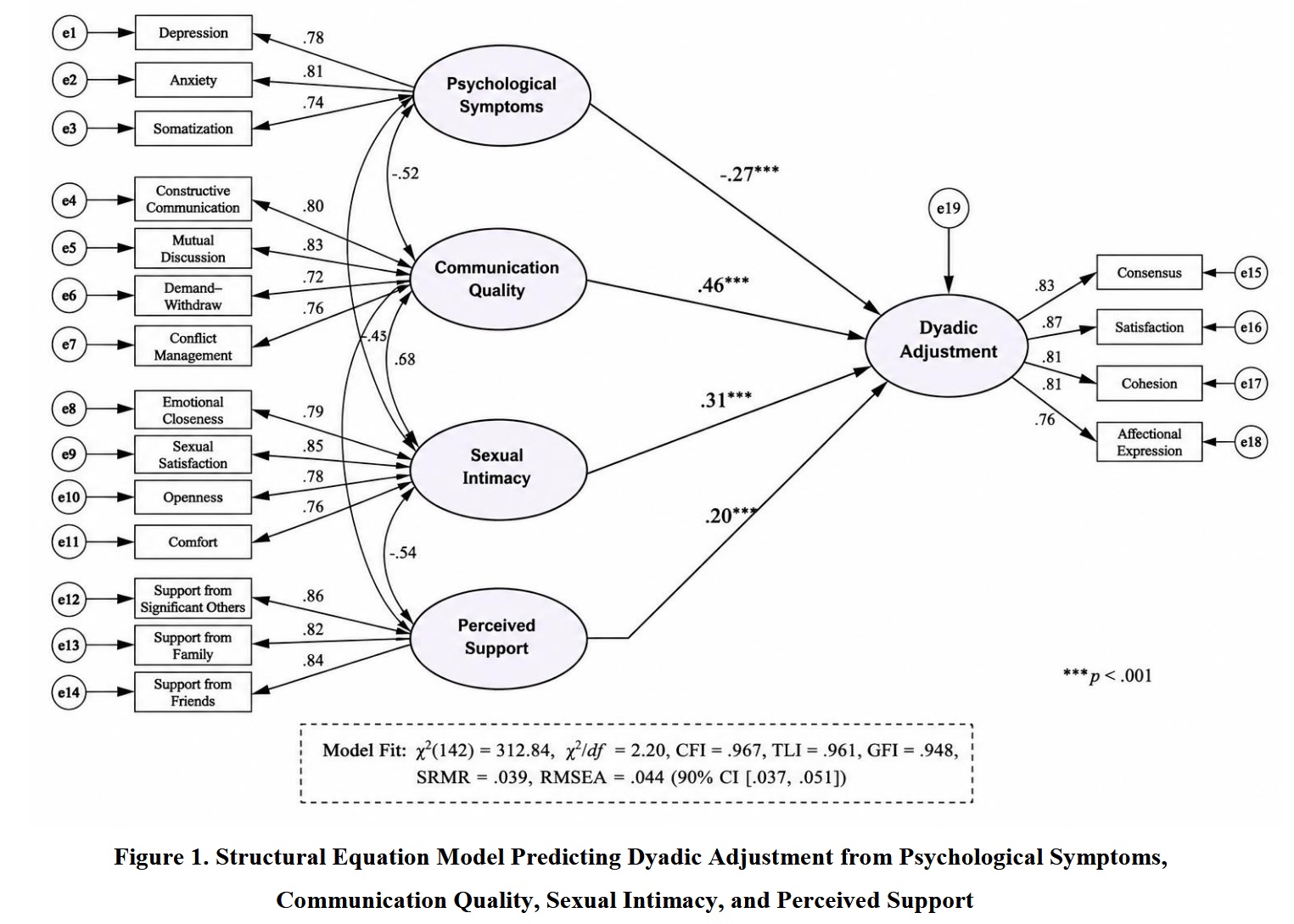
The present study aimed to predict dyadic adjustment among couples using a multimodal framework incorporating psychological symptoms, communication quality, sexual intimacy, and perceived support. This cross-sectional predictive study was conducted among 624 individuals representing 312 couples residing in Mexico. Participants were recruited through community organizations, healthcare settings, counseling centers, and online platforms. Data were collected using the Dyadic Adjustment Scale (DAS), Brief Symptom Inventory-18 (BSI-18), Communication Patterns Questionnaire–Short Form (CPQ-SF), Personal Assessment of Intimacy in Relationships Scale (PAIR), and the Multidimensional Scale of Perceived Social Support (MSPSS). Descriptive statistics, Pearson correlation analyses, hierarchical multiple regression, and structural equation modeling (SEM) were performed using SPSS 29 and AMOS 29. Model fit was evaluated using χ²/df, CFI, TLI, GFI, SRMR, and RMSEA indices. Correlation analyses indicated that dyadic adjustment was negatively associated with psychological symptoms (r = -.58, p < .001) and positively associated with communication quality (r = .74, p < .001), sexual intimacy (r = .68, p < .001), and perceived support (r = .61, p < .001). Hierarchical multiple regression analysis revealed that psychological symptoms (β = -.24, p < .001), communication quality (β = .43, p < .001), sexual intimacy (β = .29, p < .001), and perceived support (β = .18, p < .001) significantly predicted dyadic adjustment, collectively explaining 70.9% of the variance (R² = .709, p < .001). Structural equation modeling demonstrated excellent model fit (χ²/df = 2.20, CFI = .967, TLI = .961, GFI = .948, SRMR = .039, RMSEA = .044). Standardized path coefficients confirmed significant direct effects of psychological symptoms (β = -.27, p < .001), communication quality (β = .46, p < .001), sexual intimacy (β = .31, p < .001), and perceived support (β = .20, p < .001) on dyadic adjustment. The final model explained 73.4% of the variance in dyadic adjustment. The findings demonstrate that dyadic adjustment is a multidimensional relational outcome shaped by psychological, communicative, sexual, and social factors. Communication quality emerged as the strongest predictor of relationship functioning, followed by sexual intimacy, psychological symptoms, and perceived support. These results support systemic and dyadic perspectives of relationship functioning and suggest that interventions targeting communication skills, emotional well-being, intimacy enhancement, and support mobilization may substantially improve couple adjustment and relational resilience.
The Effectiveness of Trauma-Informed Couple Therapy on Attachment Security, Emotional Safety, and Intimate Partner Responsiveness among Couples with Childhood Trauma Histories
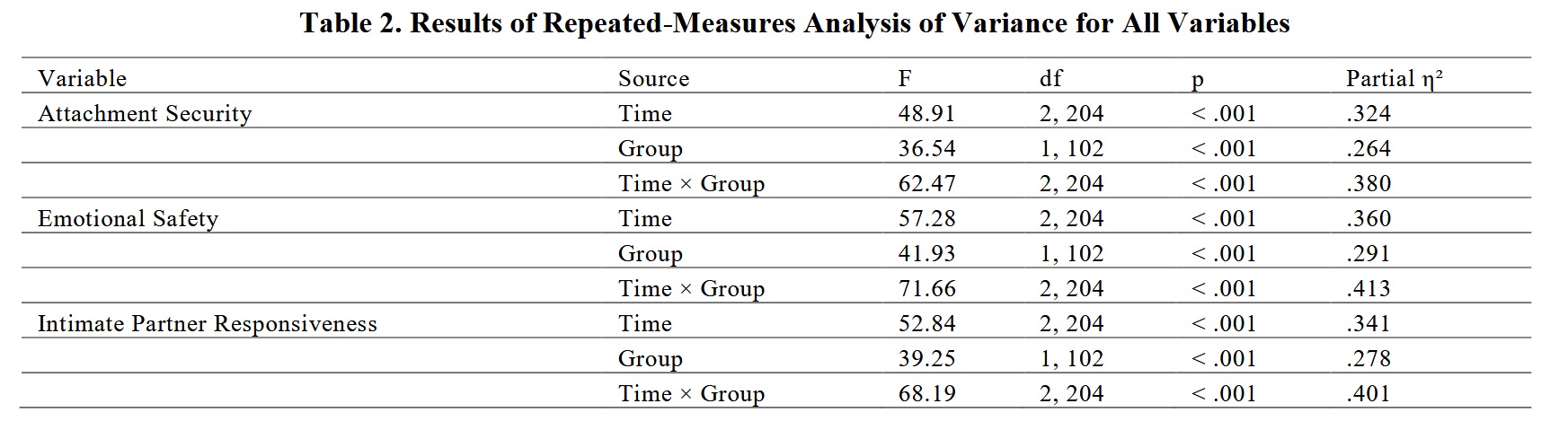
The present study aimed to examine the effectiveness of Trauma-Informed Couple Therapy (TICT) in improving attachment security, emotional safety, and intimate partner responsiveness among couples with childhood trauma histories. This quasi-experimental study employed a pre-test, post-test, and three-month follow-up design with an experimental group and a waitlist control group. The research was conducted in Canada among 52 couples (104 individuals) with documented childhood trauma histories who were recruited from community counseling centers and mental health clinics. Participants were assigned to either an experimental group (26 couples) receiving Trauma-Informed Couple Therapy or a control group (26 couples) receiving no intervention during the study period. Data were collected using the Experiences in Close Relationships-Revised Questionnaire (ECR-R) to assess attachment security, the Emotional Safety Scale for Couples (ESSC), and the Perceived Partner Responsiveness Scale (PPRS). The intervention consisted of twelve weekly 90-minute sessions integrating attachment-based, trauma-informed, emotionally focused, and relational resilience principles. Data were analyzed using repeated-measures analysis of variance and Bonferroni post hoc comparisons in SPSS version 29. The results of repeated-measures analysis of variance revealed significant Time × Group interaction effects for attachment security, F(2, 204) = 62.47, p < .001, η² = .380; emotional safety, F(2, 204) = 71.66, p < .001, η² = .413; and intimate partner responsiveness, F(2, 204) = 68.19, p < .001, η² = .401. Significant main effects of time and group were also observed across all outcome variables (p < .001). Bonferroni pairwise comparisons demonstrated significant improvements from pre-test to post-test and from pre-test to follow-up for attachment security, emotional safety, and intimate partner responsiveness in the experimental group (p < .001). No significant differences emerged between post-test and follow-up scores (p > .05), indicating maintenance of treatment gains over the three-month follow-up period. The large effect sizes obtained across all dependent variables suggest substantial intervention-related improvements in relational functioning among couples with childhood trauma histories. The findings indicate that Trauma-Informed Couple Therapy is an effective intervention for enhancing attachment security, emotional safety, and intimate partner responsiveness among couples affected by childhood trauma. By addressing trauma-related attachment disruptions, fostering emotionally safe interactions, and strengthening responsive relational processes, the intervention contributed to meaningful and sustained improvements in couple functioning. These results support the integration of trauma-informed and attachment-based approaches within couple therapy and highlight the importance of addressing the interpersonal consequences of childhood trauma in clinical practice.
About the Journal
Research and Practice in Couple Therapy is a peer-reviewed, open-access scholarly journal dedicated to advancing the science and practice of couple therapy in both clinical and community settings. As an interdisciplinary platform, the journal brings together diverse theoretical orientations, methodological approaches, and practical experiences from psychology, counseling, psychiatry, family therapy, and related disciplines. The journal serves as a critical forum for clinicians, researchers, educators, and policy-makers interested in enhancing the quality and effectiveness of interventions for couples experiencing relational, emotional, or mental health challenges.
Published quarterly, the journal upholds the highest standards of academic rigor, professional ethics, and editorial integrity. It accepts empirical research articles, theoretical papers, clinical case studies, review articles, intervention protocols, and practitioner reflections that significantly contribute to the field of couple therapy. Each manuscript undergoes a rigorous double-blind peer-review process to ensure scholarly excellence, relevance, and originality.
We especially welcome submissions that address emerging topics such as cultural sensitivity in couple therapy, technology-assisted interventions, trauma-informed relational work, LGBTQ+ couples, intercultural relationship dynamics, and the intersection between couple functioning and individual mental health.
Call for Paper
In recognition of emerging priorities, we invite researchers, clinicians, and interdisciplinary scholars to submit original manuscripts for the final issue of 2026, with particular emphasis on “Emerging Directions in Couple Therapy Research: From Evidence-Based Interventions to Digital and Culturally Responsive Practice.” We welcome empirical studies, randomized and quasi-experimental trials, systematic reviews and meta-analyses, qualitative and mixed-method investigations, methodological papers, and theoretically grounded clinical research.
Submissions addressing evidence-based couple interventions, mechanisms of therapeutic change, comparative treatment effectiveness, attachment and emotion regulation, communication and intimacy, teletherapy and digital interventions, artificial intelligence in relational care, culturally adapted couple therapy, dyadic assessment and analysis, diverse couple populations, implementation science, therapist training, and innovative models of prevention and intervention are particularly encouraged.
This special thematic focus seeks to bring together scholarship that can advance couple therapy beyond conventional boundaries and strengthen its scientific, technological, and cultural relevance. Authors whose work contributes to a more precise, accessible, inclusive, and evidence-informed understanding of couple relationships are warmly encouraged to submit their manuscripts for consideration in the last issue of 2026.
Current Issue